
1,4-Butanediol (BDO) Production via Aerobic Batch Fermentation
Project Description
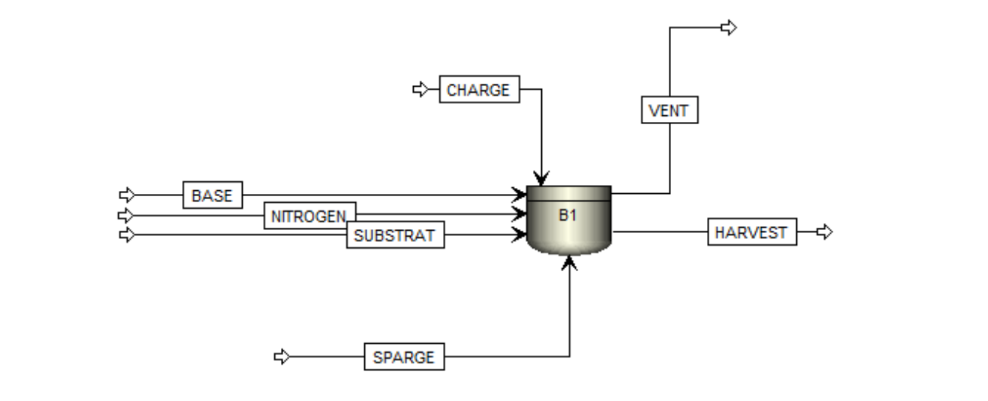
The bio-based production of 1,4-Butanediol (BDO) through aerobic batch fermentation presents a sustainable alternative to conventional petrochemical routes. The process initiates with the preparation of a nutrient-rich fermentation medium containing glucose as the primary carbon source, ammonium sulfate as the nitrogen source, and a metabolically engineered microbial culture capable of converting sugars into BDO. These components are introduced into a controlled batch bioreactor operating under sterile conditions to ensure optimal biological activity.
As fermentation proceeds, sterile air is sparged continuously into the reactor to maintain aerobic conditions essential for microbial respiration and metabolic conversion. Oxygen dissolves in to the liquid phase and supports biomass growth, which occurs simultaneously with substrate consumption and BDO synthesis. The engineered metabolic pathway channels glucose carbon toward BDO formation, while minor by-products such as acetate, ethanol, γ-butyrolactone(GBL), and γ-hydroxybutyric acid (GHB) are formed due to secondary metabolic fluxes. To maintain enzymatic stability and prevent metabolic inhibition, pH is regulated through controlled addition of potassium hydroxide.
The batch operation continues until the desired BDO mass accumulation is achieved, after which substrate feeding is terminated and the fermentation broth is withdrawn for down stream purification. Industrially, BDO serves as a key precursor for tetrahydrofuran (THF), polybutylene terephthalate (PBT), elastomers, and high-performance solvents, making its renewable production highly valuable for sustainable chemical manufacturing.
Process Flow Diagarm
Optimization Strategy
The optimization strategy focuses on maximizing BDO yield and productivity while ensuringstable microbial growth and controlled impurity formation. Since aerobic fermentation kinetics are strongly dependent on oxygen availability, the primary optimization variable selected is the volumetric oxygen mass transfer coefficient (kLa). Enhancing kLa improves dissolved oxygen concentration, which directly increases biomass activity and accelerates substrate conversion to BDO
Simultaneously, the glucose feed rate is optimized to align with microbial metabolic capacity. Excess substrate accumulation can shift cellular metabolism toward by-product formation, thereby lowering selectivity. A controlled feeding approach ensures efficient carbon utilization and maintains steady metabolic flux toward BDO production. Furthermore, implementing a product-based batch termination condition enhances operational consistency and prevents over-processing. This integrated optimization improves overall conversion efficiency, reduces energy wastage, and enhances process robustness for industrial deployment.
Reaction Kinetics and Biochemical Pathway
The fermentation follows growth-associated product formation kinetics, where biomass growth, substrate consumption, and BDO synthesis occur concurrently. Oxygen acts as a limiting substrate under aerobic conditions, influencing both growth rate and product yield. Incorporating oxygen limitation terms into the kinetic model enables realistic prediction of reactor performance and dynamic concentration profiles throughout the batch cycle.
Oxygen Mass Transfer Dynamics
Oxygen transfer from the gas phase to the liquid phase governs the efficiency of aerobic fermentation due to its low solubility in aqueous media. Agitation and air sparging enhance gas–liquid contact, thereby increasing mass transfer rates. The kLa parameter serves as a critical design and operational variable linking hydrodynamics to biological productivity. Proper control of oxygen transfer prevents metabolic stress and sustains optimal fermentation conditions.
Process Control and Operational Stability
Maintaining stable environmental conditions is essential for consistent reactor performance. Temperature control ensures optimal enzymatic activity, while automated pH regulation prevents microbial inhibition. Continuous monitoring of substrate concentration, dissolved oxygen levels, and product accumulation enables accurate process control and reproducible batch operation. These control measures enhance process reliability and minimize variability.
Projects Insight
Oxygen Limitation Effect
- Dissolved oxygen concentration directly influences biomass growth rate.
- Insufficient oxygen reduces metabolic efficiency and lowers BDO productivity.
- Maintaining optimal kLa is essential for sustaining aerobic conditions
pH Control Sensitivity
- Microbial enzymes operate effectively within a narrow pH range.
- Deviations from optimal pH can reduce growth and product formation rates.
- Automated base addition stabilizes biochemical performance
Substrate Feeding Strategy
- Controlled glucose feeding prevents substrate inhibition and overflow metabolism.
- Balanced feeding improves carbon conversion efficiency toward BDO.
- Proper feed regulation enhances product selectivity and reduces impurities.
Batch Termination Criterion
- Product-based stopping conditions ensure consistent production targets.
- Prevents over-fermentation and unnecessary energy consumption.
- Improves batch-to-batch reproducibility and operational efficiency
By-Product Formation Behavior
- Formation of acetate and ethanol indicates metabolic imbalance.
- Excess by-products increase downstream purification complexity.
- Monitoring impurity trends helps optimize fermentation stability
Scale-Up Considerations
- Oxygen transfer efficiency decreases in larger reactors due to hydrodynamic changes.
- Maintaining equivalent kLa values during scale-up is technically challenging.
- Reactor design adjustments are required to preserve productivity at industrial scale
Conclusion
The aerobic batch fermentation process for 1,4-Butanediol production integrates controlled microbial growth, regulated substrate feeding, and optimized oxygen mass transfer to achieve high product yield and operational stability. By enhancing kLa and aligning substrate supply with metabolic demand, the process improves conversion efficiency while minimizing impurityformation. Implementation of structured control strategies ensures reproducible batch performance and industrial scalability. Collectively, the optimized framework strengthens the feasibility of renewable BDO production and supports sustainable chemical manufacturing advancement.