
Activated Energy Analysis for Heat Exchanger Network Optimization
Project Description
Improving energy efficiency has become a critical priority in modern process industries due to rising utility costs and stringent environmental regulations. This project applies Activated Energy Analysis to evaluate and optimize the heat exchanger network of a simplified ethylene back-end separation process. The process begins with hot cracked gas exiting the furnace, which must be cooled before entering downstream separation units. A portion of this cooling demand is met through process-to-process heat recovery using cold methane and hydrogen streams from the demethanizer overhead, while the remaining duty is supplied by external refrigeration utilities.
Following temperature conditioning, the stream is routed through a sequence of fractionation columns to recover valuable products such as ethylene, propylene, and C4 hydrocarbons. Because large temperature changes occur across multiple process units, the performance of the heat exchanger network significantly influences overall energy consumption and operating cost. Activated Energy Analysis is implemented within the simulation framework to evaluate existing heat recovery performance, identify inefficiencies, and quantify opportunities for network improvement.
The developed analysis framework enables systematic identification of energy-saving potential, reduction of external utility demand, and evaluation of retrofit alternatives that enhance thermal integration. By improving heat recovery, the optimized network supports lower operating costs, reduced greenhouse gas emissions, and improved sustainability. Such optimization approaches are widely applied in petrochemical and refinery operations where effective heat integration directly impacts plant profitability and long-term operational competitiveness.
Optimization Strategy
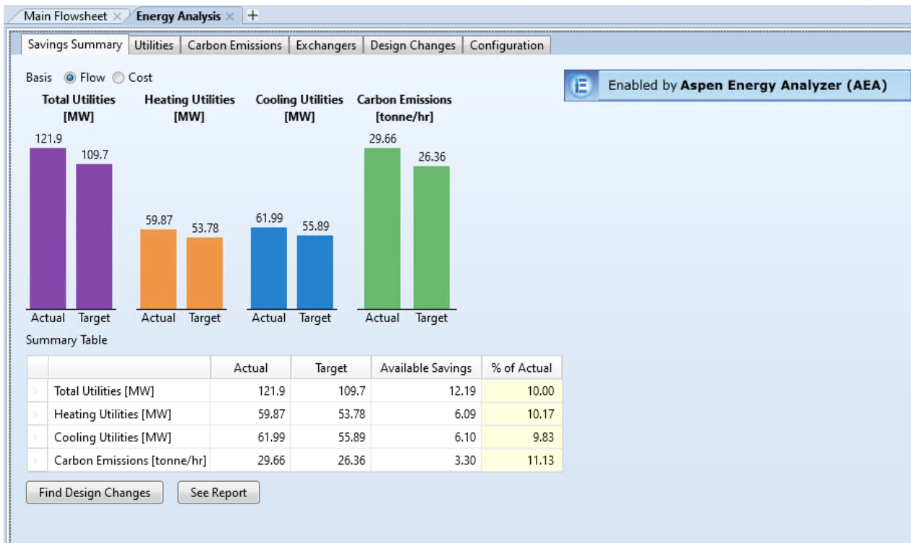
The optimization approach focuses on minimizing total energy consumption while maintaining a practical balance between capital investment and operating cost. The first step involves establishing the current energy baseline by analyzing existing utility usage and comparing it with the theoretical minimum energy requirement obtained through heat integration targeting. This gap analysis identifies the potential for energy savings and highlights the areas of the heat exchanger network that require improvement.
Based on this assessment, multiple retrofit options are evaluated, including increasing the heat transfer area of existing exchangers, adding new exchangers at thermodynamically favorable locations, and relocating units to improve temperature matching between hot and cold streams. Practical design constraints such as minimum temperature approach and maximum allowable area addition are incorporated to ensure industrial feasibility. This strategy enables significant reduction in external refrigeration demand, improves thermal efficiency, and enhances overall process economics while maintaining realistic implementation conditions.
Heat Integration and Energy Targeting
Heat integration analysis establishes the maximum achievable energy recovery within the process by identifying optimal matches between hot and cold streams. By minimizing temperature driving force losses and improving thermal matching, the process moves closer to thermodynamic efficiency limits. Energy targeting provides a quantitative benchmark for evaluating retrofit performance and ensures that network modifications effectively reduce reliance on external heating and cooling utilities.
Retrofit Design Alternatives
Multiple retrofit configurations are generated to explore practical pathways for improvingnetwork performance. Increasing the surface area of existing exchangers enhances heatrecovery with minimal structural changes. The addition of new exchangers creates additionalrecovery paths between suitable streams, while relocation of existing units improvestemperature alignment within the network. These alternatives provide operational flexibility andallow selection of solutions based on plant layout constraints, available space, and investmentpriorities.
Economic and Environmental Assessment
Each retrofit scenario is evaluated for economic viability by comparing capital investmentrequirements with projected annual utility cost savings. Payback period is used as a keydecision parameter for implementation. In addition to economic benefits, reduced utilityconsumption lowers fuel demand and associated greenhouse gas emissions, contributing toimproved environmental performance and regulatory compliance.
Projects Insight
Energy Saving Potential Identification
- Initial analysis quantifies the gap between current and target energy consumption.
- This helps prioritize heat exchanger modifications with the highest impact.
- Even small network changes can result in noticeable utility reduction.
Retrofit Feasibility Constraints
- Initial analysis quantifies the gap between current and target energy consumption.
- This helps prioritize heat exchanger modifications with the highest impact.
- Even small network changes can result in noticeable utility reduction.
Capital–Energy Trade-off Behavior
- Increasing heat transfer area improves energy recovery but raises capital cost.
- Optimization balances area addition against operating savings.
- Constraint-based refinement helps achieve economically realistic solutions.
Utility and Emission Reduction Impact
- Lower refrigeration and cooling demand reduces operating energy consumption.
- Reduced energy usage leads to lower carbon emissions.● Energy optimization supports both economic and environmental performance
Importance of Temperature Approach Limits
- Minimum temperature difference directly affects heat recovery feasibility.
- Very low approach temperatures significantly increase exchanger size.
- Proper selection ensures practical and cost-effective designs.
Sensitivity to Network Configuration
- Overall savings strongly depend on existing exchanger placement and thermal matching.
- Processes with poor initial heat integration show higher improvement potential.
- Detailed network evaluation is essential before implementing retrofit decisions.
Conclusion
Activated Energy Analysis provides a structured and practical methodology for enhancing the thermal efficiency of heat exchanger networks in ethylene separation processes. By identifying energy-saving opportunities and evaluating retrofit options such as area enhancement, exchanger addition, and unit relocation, the approach enables significant reductions in external utility consumption. Incorporating economic constraints ensures an optimal balance between capital investment and operating cost savings. In addition to improving process economics, the optimized network contributes to reduced greenhouse gas emissions and enhanced sustainability. Overall, the methodology supports informed decision-making for achieving energy-efficient, cost-effective, and environmentally responsible plant operation.