
Biogas Production Simulation for Anaerobic Digestion of Livestock Manure Using Aspen Plus
Project Description
This project focuses on the simulation of biogas production from livestock manure through anaerobic digestion using Aspen Plus. Anaerobic digestion is a biological conversion process in which microorganisms decompose organic waste in the absence of oxygen, producing methane-rich biogas that can be used as a renewable energy source. In addition to generating clean energy, the process reduces greenhouse gas emissions and transforms agricultural waste into a valuable resource.
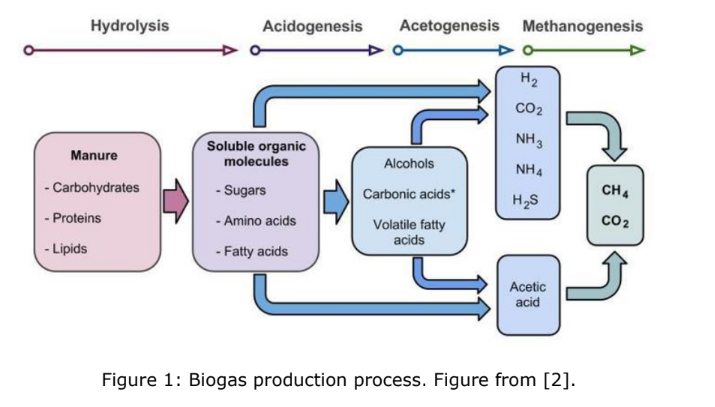
Livestock manure contains complex organic compounds including proteins, lipids, carbohydrates, and volatile fatty acids, along with inorganic nutrients and ash content. The digestion process occurs through sequential microbial stages, where different microbial communities cooperate to convert complex organic matter into methane and carbon dioxide. In the first stage, hydrolysis breaks down large organic molecules into soluble substrates such as sugars and amino acids. These intermediates are then converted by acetogenic bacteria into volatile fatty acids. Finally, methanogenic bacteria consume these acids and produce methane-rich biogas.
The Aspen Plus model incorporates fermentation kinetics and batch reactor systems to simulate mixed microbial cultures and their interactions. Substrate degradation, biomass growth, intermediate formation, inhibition effects, and methane production are tracked over time. This integrated modeling framework provides a continuous representation of biological conversion behavior and supports process design, optimization, and industrial-scale performance evaluation.
Process Flow Diagarm
Optimization Strategy
The operational strategy aims to maximize methane yield while maintaining stable microbial activity and efficient waste conversion. Feed composition and solids concentration are carefully controlled to ensure consistent substrate availability for microbial populations. Nutrient balance is maintained to support microbial growth, with potassium acting as a limiting nutrient for methanogenic bacteria. At the same time, ammonia concentration is monitored because excessive levels inhibit acetogenic bacteria and disrupt the balance between microbial communities.
The digestion system operates under optimized batch conditions that allow proper microbial growth phases and sustained methane generation. Retention time is selected to ensure adequate substrate conversion while avoiding excessive reactor sizing. Continuous monitoring of volatile fatty acid accumulation, biomass concentration, and methane production rate ensures early detection of instability. Maintaining balanced acid levels prevents process inhibition and supports steady biogas output. These coordinated operational controls improve energy recovery, biological stability, and overall process efficiency
. Model Framework and Assumptions
Manure and microbial cultures are defined as biocomponents using Aspen Plus BIOFEED and FERMENT databases. Manure composition is specified on a dry basis using CHON and ash content to ensure accurate mass and energy balance representation. The BIOIDEAL property method is applied to estimate thermodynamic properties such as enthalpy and density for complex biological materials. Two primary microbial groups are modeled: acetogenic bacteria (AGB) and methanogenic bacteria (MGB). The model incorporates growth kinetics, substrate utilization, product formation, and inhibition effects. Ammonia inhibition on acetogenic bacteria and nutrient limitation effects on methanogenic growth are included to reflect realistic biological behavior and maintain model reliability.
Reaction and Biological Conversion
The anaerobic digestion process is represented through sequential biological reactions. Hydrolysis converts complex organic compounds into soluble substrates. Acetogenic bacteria metabolize these substrates to form volatile fatty acids, primarily represented as acetic acid. Methanogenic bacteria subsequently convert these acids into methane and carbon dioxide through anaerobic respiration pathways. Power-law and Monod-type kinetic expressions are applied to represent microbial growth dynamics and substrate consumption. Custom rate expressions are incorporated to simulate inhibition effects and delayed microbial activation, allowing the model to replicate experimentally observed digestion trends and methane production profiles.
Projects Insight
Importance of Microbial Balance
- Stable interaction between acetogenic and methanogenic bacteria ensures efficient digestion.
- Imbalance leads to acid accumulation and reduced methane production.
- Proper nutrient control maintains long-term microbial stability
Volatile Fatty Acid Control
- Excess acid accumulation indicates microbial imbalance.
- High acid concentration lowers pH and inhibits methane production.
- Balanced acid conversion enhances overall biogas productivity
Effect of Ammonia Inhibition
- High ammonia concentration suppresses acetogenic activity.
- Reduced acid conversion negatively affects methane formation.
- Monitoring nitrogen levels improves process reliability
Retention Time Optimization
- Adequate digestion time ensures complete substrate utilization.
- Short retention reduces gas yield, while excessive time increases reactor volume.
- Optimized batch duration improves economic performance.
Role of Nutrient Limitation
- Trace nutrients such as potassium regulate methanogenic growth.
- Limiting nutrients help control excessive biomass buildup.
- Optimized dosing improves gas yield and stability
Model Flexibility for Optimization
- Aspen Plus kinetic models allow calibration with plant data.
- Process parameters can be adapted for different waste compositions.
- The model supports scale-up and performance enhancement studies
Conclusion
The Aspen Plus simulation successfully represents biogas production from livestock manure through detailed anaerobic digestion modeling and fermentation kinetics integration. By incorporating substrate degradation pathways, microbial growth dynamics, inhibition mechanisms, and nutrient limitations, the model captures the complex biological interactions that govern methane generation. The results highlight the importance of maintaining microbial balance, controlling ammonia concentration, optimizing retention time, and managing nutrientavailability to achieve stable and efficient biogas production. This comprehensive simulation framework provides valuable insight into reactor performance and supports design, optimization, and scale-up of industrial anaerobic digestion systems. Ultimately, the project demonstrates a sustainable approach to waste management and renewable energy generation, contributing to environmental protection and energy recovery in agricultural and industrial sectors.