
Implementation of User-Defined Viscosity Modeling for Heavy Petroleum Streams in Aspen Plus
Project Description
Accurate viscosity prediction plays a critical role in petroleum process simulation, particularly for heavy fractions where transport properties strongly influence pressure drop, pumping requirements, and heat transfer calculations. Standard API-based viscosity correlations in Aspen Plus often fail to provide reliable estimates for highly viscous petroleum streams. This project addresses the challenge of incorporating experimentally measured viscosity data into the simulation when direct stream or assay input is not supported by the software.
In this case, two experimental viscosity measurements — 2800 cP at 275°F and 600 cP at 325°F — are available for a heavy petroleum fraction. Since Aspen Plus does not allow direct entry of viscosity data for petroleum streams, a user-defined Fortran subroutine (MUL2USR) is implemented to replace the default mixture viscosity model. The subroutine interpolates
viscosity values using a temperature-dependent logarithmic model of the form ln(μ) = A + B/T, where viscosity is expressed in Pa·s and parameters A and B are derived from the experimental data.
In this case, two experimental viscosity measurements — 2800 cP at 275°F and 600 cP at 325°F — are available for a heavy petroleum fraction. Since Aspen Plus does not allow direct entry of viscosity data for petroleum streams, a user-defined Fortran subroutine (MUL2USR) is implemented to replace the default mixture viscosity model. The subroutine interpolates viscosity values using a temperature-dependent logarithmic model of the form ln(μ) = A + B/T, where viscosity is expressed in Pa·s and parameters A and B are derived from the experimental data.
Optimization Strategy
The optimization strategy focuses on ensuring numerical stability and realistic viscosity behavior across the defined temperature range. The model parameters A and B are determined using regression analysis of the available experimental data after converting viscosity into consistent SI units (Pa·s). Validation checks are performed to confirm smooth interpolation between
temperature points and prevent unrealistic extrapolation beyond the measured range.
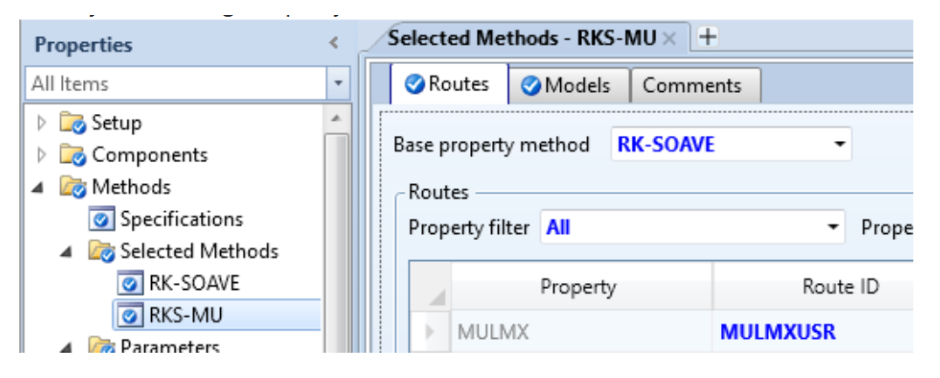
To enhance robustness, the property method is carefully configured so that MULMXUSR replaces the default viscosity route (MULMX). The user parameter MUUSR is defined as temperature-dependent with two elements corresponding to coefficients A and B. Special attention is given to component ordering, since the subroutine reads parameters from the first component in the list. This structured implementation improves convergence behavior and ensures consistent simulation performance in heavy oil processing applications.
Property Method Modification
The existing property method is customized to redirect mixture viscosity calculations through the
user-defined routine. By assigning the MULMX route to MULMXUSR, Aspen Plus calls the external Fortran subroutine during each property evaluation step. This modification allows complete control over viscosity calculation without altering other thermodynamic property predictions.
User Parameter Configuration
A temperature-dependent user parameter (MUUSR) is added to the property method with two elements representing coefficients A and B. These parameters are entered for the first component in the component list, as required by the subroutine structure. Proper configuration ensures that the model retrieves the correct constants during runtime.
Fortran Subroutine Compilation and Integration
The MUL2USR Fortran code is compiled using the ASPCOMP command within the Aspen Plus customization window. Once compiled, the subroutine becomes accessible during simulation execution. Proper compilation and linking are essential to guarantee stable performance and prevent undefined property behavior.
Projects Insight
Limitations of Built-in Petroleum Correlations
● API methods may underpredict high viscosities
● Accuracy decreases for heavy residues
● Custom models improve property reliability
Importance of Experimental Data Utilization
● Even two data points can enhance accuracy
● Regression-based interpolation improves prediction
● Real data reduces design uncertainty
Role of User Subroutines in Aspen Plus
● Extends software flexibility beyond defaults
● Enables advanced customization of transport properties
● Supports specialized industrial modeling needs
Temperature-Dependent Modeling Benefits
● Correct component assignment is critical
● Improper parameter definition leads to undefined behavior
● Hardcoding parameters increases independence from component order
Impact on Process Design and Equipment Sizing
● Accurate viscosity improves pressure drop estimation
● Influences pump and heat exchanger design
● Reduces risk in scale-up studies
Implementation Considerations
● Correct component assignment is critical
● Improper parameter definition leads to undefined behavior
● Hardcoding parameters increases independence from component order
Conclusion
This project demonstrates a practical and technically sound approach to incorporating experimental viscosity data for heavy petroleum streams in Aspen Plus through a user-defined Fortran subroutine. By replacing the default mixture viscosity model with a temperature-dependent logarithmic interpolation function, the limitations of standard API correlations are effectively addressed. The optimized integration of MUL2USR enhances simulation accuracy, improves transport property prediction, and strengthens confidence in process design and operational analysis. This methodology provides a valuable solution for refinery engineers and process modelers working with complex heavy hydrocarbon systems.