
Modeling External Condensation Effects in Air Coolers Using Aspen EDR
Project Description
This project focuses on evaluating the capability of Aspen Exchanger Design & Rating (EDR) torepresent condensation occurring on the outside surface of air cooler tubes. Air coolers are widely used in industrial plants for heat removal using ambient air, and under certain environmental conditions, moisture present in the air may condense on the external tube surface. Accurate representation of this phenomenon is important because external condensation can influence heat transfer performance, pressure drop, and overall equipment efficiency. The study investigates the limitations of the standard Air Cooler model and explores alternative modeling approaches to represent real operating conditions more accurately.
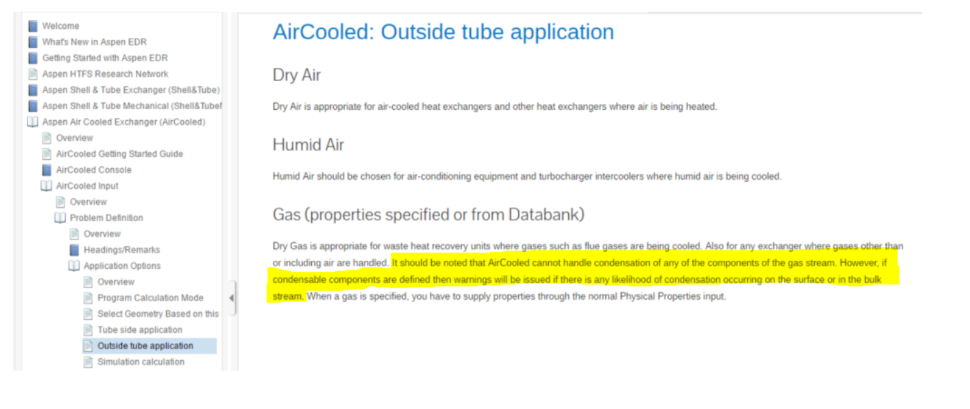
In the standard EDR Air Cooler configuration, external condensation is not calculated when the outside stream is defined as a gas. Even when the Humid Air option is selected, the software accounts for the thermal effects of moisture but does not explicitly report the condensed liquid flow. To address this limitation, this project develops an alternative modeling strategy using a Shell & Tube heat exchanger configuration to simulate cross-flow air cooling conditions. This approach allows the external stream to be treated as a humid gas mixture, enabling the evaluation of condensation effects on thermal performance.
The developed model represents industrial air cooler operation by configuring an X-type shell to simulate cross-flow air behavior, where each shell-side inlet corresponds to an individual air cooler bay. The external air stream is modeled as a gas or humid air mixture, while the process fluid flows through the tube side. This framework enables detailed thermal analysis, performance evaluation, and sensitivity assessment, providing a practical workaround for engineers who need to analyze external condensation effects in air cooling systems.
Process Flow Diagarm
Optimization Strategy
The optimization strategy focuses on improving the accuracy and reliability of external heat transfer predictions under varying atmospheric conditions. Key operating variables such as ambient temperature, humidity level, and air flow rate are adjusted to evaluate their impact on condensation potential and overall heat transfer performance. By simulating different environmental scenarios, the model helps identify operating conditions where external condensation significantly enhances cooling efficiency or introduces operational concerns such as corrosion risk.
In addition, the Shell & Tube workaround configuration is optimized to represent real air cooler geometry and flow distribution. Multiple shell-side inlets are used to simulate individual air cooler bays, allowing better representation of cross-flow characteristics. Parameter tuning for heat transfer coefficients, flow distribution, and thermal duty ensures that the model provides realistic performance trends, supporting equipment design evaluation and operational decision-making.
Shell & Tube Cross-Flow Representation
To simulate air cooler behavior, an X-type shell configuration is used to represent cross-flow air movement across tube bundles. Each shell-side inlet corresponds to a separate air cooler bay, enabling flexible modeling of multi-bay systems. This configuration allows engineers to analyze the thermal interaction between process fluid and external air under realistic flow conditions.
Humid Air Thermal Behavior
The external stream is defined as a humid air mixture to capture the thermodynamic effects of moisture during cooling. Changes in humidity influence the dew point and determine whether condensation occurs on the tube surface. Incorporating humid air properties improves the accuracy of heat transfer predictions and allows assessment of environmental impacts on cooler performance
Industrial Application and Performance Evaluation
The developed modeling approach supports evaluation of real plant scenarios where air coolers operate under varying ambient conditions. Engineers can analyze seasonal performance variations, cooling limitations, and potential efficiency gains due to external condensation. The framework also helps assess operational risks such as moisture-related corrosion or fouling tendencies
Projects Insight
Limitation of Standard Air Cooler Model
● Humid Air option includes thermal effects but not liquid flow reporting.
Importance of Humidity Conditions
- High humidity increases the likelihood of external condensation.
- Dew point temperature determines condensation onset.
- Environmental conditions significantly affect cooling performance
Shell & Tube Workaround Advantage
- Allows representation of cross-flow air conditions.
- Enables thermal evaluation of condensation effects.
- Provides flexibility for multi-bay air cooler modeling.
Effect on Heat Transfer Performance
- External condensation increases overall heat transfer coefficient.
- Improves cooling capacity under favorable conditions.
- Performance varies with ambient temperature and airflow.
Multi-Bay System Representation
- Each shell-side inlet represents one air cooler bay.
- Supports analysis of large industrial air cooling units.
- Improves flow distribution accuracy
Operational Risk Considerations
- Condensation may increase corrosion potential.
- Moisture accumulation can affect equipment reliability.
- Proper material selection and monitoring are essential.
Conclusion
This project presents a practical methodology for evaluating external condensation effects in air coolers using Aspen EDR despite limitations in the standard Air Cooler model. By implementing a Shell & Tube cross-flow configuration with humid air properties, the developed framework enables realistic thermal analysis under varying environmental conditions. The study highlights the importance of humidity, ambient temperature, and system configuration in determining heat transfer performance and operational reliability. This approach provides valuable support for equipment design, performance evaluation, and operational optimization in industrial air cooling applications.