
Modeling Retrograde Condensation in Petroleum Gas Systems Using Aspen Plus
Project Description
This project investigates the phenomenon of retrograde condensation in petroleum gas systems using Aspen Plus. Retrograde condensation occurs in gas condensate fluids, typically rich in heavy hydrocarbons, when a single-phase gas at high pressure and temperature experiences liquid dropout upon pressure reduction at constant temperature. Understanding this behavior is critical for reservoir engineering, process design, and production optimization, as liquid formation in the gas phase can affect separation efficiency, pipeline operation, and production equipment performance.
The project demonstrates the use of Aspen Plus to model retrograde condensation using representative hydrocarbon mixtures such as ethane-heptane systems. By evaluating mixtures with different compositions, it highlights how retrograde condensation is sensitive to overall component concentration and phase behavior. For instance, an 88.7 mol% ethane-heptane mixture exhibits retrograde condensation under certain conditions, while a 26.5 mol% mixture does not, illustrating the importance of composition in phase behavior analysis.
The Aspen Plus model employs a Flash2 block to simulate pressure variations at constant temperature, capturing the onset of condensation and subsequent vapor-liquid equilibria. Sensitivity analyses are performed to track changes in vapor fraction as pressure is varied, providing insight into how retrograde condensation develops under reservoir-like conditions. This approach enables engineers to predict liquid dropout, evaluate operational risks, and design appropriate separation and processing strategies for gas condensate systems.
Process Flow Diagarm
Optimization Strategy
The optimization strategy aims to provide accurate and reliable modeling of retrograde condensation phenomena while improving computational efficiency. Pressure and temperature are systematically varied in the Flash2 block to identify critical points where liquid dropout occurs. This allows for targeted evaluation of operating ranges in which retrograde condensation can impact pipeline and separator design, ensuring that equipment can handle liquid accumulation without compromising safety or performance.
Additionally, sensitivity analysis is used to explore the effects of varying gas composition, total flow, and operating conditions on the extent of condensation. By systematically adjusting these parameters, engineers can optimize process design, determine safe operating limits, and implement mitigation strategies such as pressure control or phase separation optimization. This methodology enhances predictive capability and supports informed decision-making for production and processing of gas condensate streams.
Phase Behavior Analysis
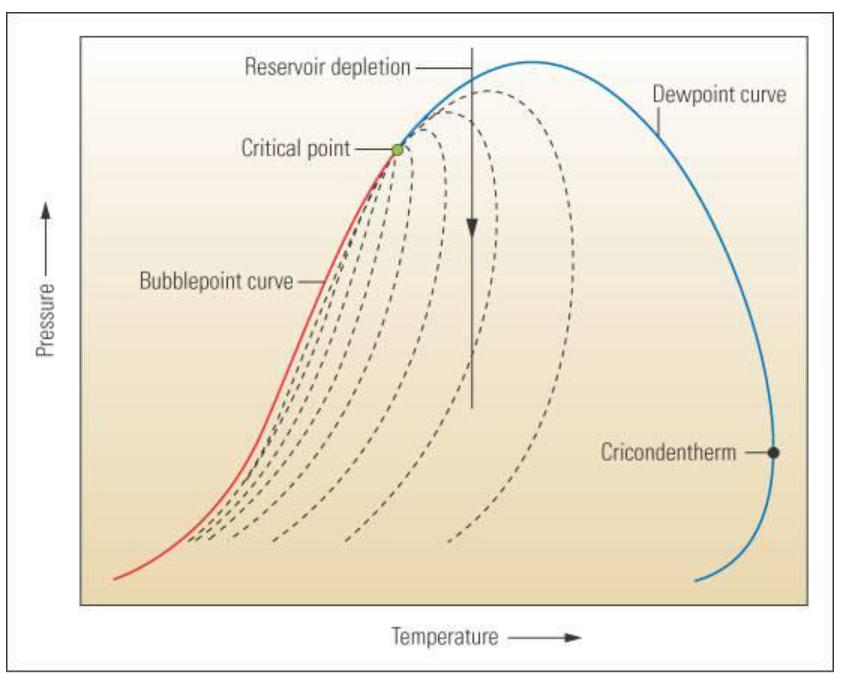
Retrograde condensation is analyzed by generating phase envelopes for mixtures with varying compositions. Phase diagrams illustrate the critical point, dew point, and liquid formation region, showing how heavy hydrocarbon content governs condensation behavior. This analysis is essential for understanding when and where retrograde condensation occurs in the process.
Flash2 Block Implementation
The Flash2 block in Aspen Plus is configured with a design specification to vary pressure at constant temperature. This setup allows precise calculation of vapor and liquid fractions across the pressure range, enabling engineers to predict condensation onset and quantify the vapor-liquid split in real gas condensate systems.
Sensitivity Analysis
By performing sensitivity studies, the model tracks vapor fraction changes as a function of pressure. This provides insight into retrograde condensation dynamics and helps identify theoptimal operating conditions to minimize liquid dropout, ensuring smoother production and safer handling of gas stream
Projects Insight
Effect of Gas Composition
○ High heavy hydrocarbon content increases the likelihood of retrograde
condensation.
○ Lower light-component ratios may prevent condensation.
○ Composition analysis is critical for accurate phase prediction.
Pressure-Dependent Condensation
○ Liquid formation occurs as pressure decreases at constant temperature.
○ Flash2 simulations reveal critical pressure points.
○ Enables planning for separation and pipeline design.
Phase Envelope Significance
○ Phase diagrams identify dew points and critical regions.
○ Provide visual guidance for operational limits.
○ Useful for design and production optimization.
Sensitivity Analysis Utility
○ Tracks vapor fraction under varying pressures.
○ Allows evaluation of operational strategies to avoid liquid dropout.
○ Supports risk assessment for condensate handling
Operational Implications
○ Retrograde condensation affects pipeline and separator design.
○ Understanding onset prevents equipment overload or damage.
○ Supports better planning for gas processing units
Predictive Modeling Advantages
○ Aspen Plus provides quantitative predictions of condensation behavior.
○ Helps optimize process parameters in gas condensate systems.
○ Reduces uncertainty in field operations.
Conclusion
This project demonstrates the use of Aspen Plus to model retrograde condensation in petroleum gas systems, emphasizing the critical role of composition, pressure, and temperature on phase behavior. By integrating Flash2 blocks with sensitivity analysis and phase envelope evaluation, engineers can predict liquid dropout, optimize operating conditions, and ensure safe and efficient handling of gas condensate streams. This approach provides valuable guidance for design, operational planning, and production management in hydrocarbon processing