
Integer Variable Optimization in Distillation Columns Using Aspen Plus
Project Description
This project explores the challenge of optimizing integer variables in Aspen Plus, with a focus on column feed stage location. While Aspen Plus Optimizer is designed to handle continuous real variables, certain process decisions, such as selecting a feed stage in a distillation column, inherently involve integer values. Optimizing these integer parameters directly can lead to convergence issues due to the truncation of values, which affects Jacobian and Hessian calculations in gradient-based algorithms. Understanding these limitations is critical for process engineers seeking to improve separation efficiency and energy consumption in column operations.
The project demonstrates a practical workaround using a combination of sensitivity analysis, calculator blocks, and parameter manipulation to approximate integer variable optimization. By converting a real-valued optimization variable into an integer within a calculator block, engineers can manipulate feed stage selection effectively while still leveraging the Aspen Plus optimization framework. This approach allows for systematic evaluation of column performance and energy requirements, even under discrete operating choices.
The Aspen Plus model integrates a split-feed strategy to distribute feed streams across multiple stages, a calculator block to convert continuous variables into discrete stage assignments, and an optimization setup to minimize total column energy consumption. Sensitivity studies and iterative simulations provide insight into the effect of feed stage selection on column efficiency, demonstrating how integer approximations can be applied to real-world distillation optimization problems.
Optimization Strategy
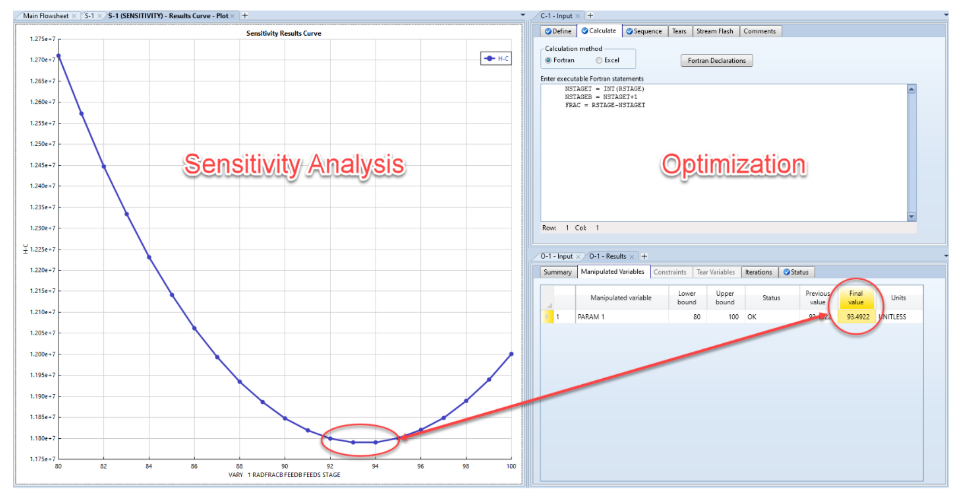
The optimization strategy focuses on approximating integer variables as continuous parameters, which are then converted to integers via calculator blocks. For a single-feed column, a global real parameter is manipulated by the optimizer to determine the optimal stage. Within the calculator block, the real value is truncated to assign feed stages for the top and bottom streams, and the flow fraction is adjusted accordingly. This approach enables the optimizer to explore feasible solutions without violating the discrete nature of stage selection.
For more complex scenarios with multiple feed streams or multivariable optimization problems, the strategy is extended to combine sensitivity analysis with the calculator-split approach. Sensitivity studies are used to graphically determine near-optimal integer values, while the continuous approximation allows gradient-based optimization algorithms (SQP, Complex, or BOBYQA) to operate effectively. This combined method ensures that integer constraints are respected while still benefiting from automated optimization capabilities.
Feed Stage Approximation Technique
A split-feed configuration is implemented, where the feed stream is divided into top and bottom fractions. The calculator block receives a real-valued parameter, truncates it to assign discrete feed stages, and calculates the flow fraction for the bottom feed. This enables realistic modeling of feed distribution while allowing the optimizer to manipulate a continuous variable.
Multi-Feed Optimization
For columns with multiple feeds, separate calculator-split combinations are used for each feed stream. Each feed has a corresponding real parameter that the optimizer adjusts, which is then converted to stage assignments for proper distribution within the column. This strategy allows complex feed configurations to be optimized simultaneously
Energy Minimization Application
The primary application demonstrated is minimizing total column energy consumption by optimizing feed stage placement. By systematically adjusting the integer-approximated feed stage and evaluating column energy requirements, engineers can identify the optimal feed distribution that reduces reboiler duty and improves overall separation efficiency.
Projects Insight
Integer Variable Limitation
- Direct optimization of integers may cause convergence failures.
- Truncation affects Jacobian and Hessian calculations.
- Continuous approximation provides a practical workaround
Algorithm Selection Implications
- SQP and Complex methods may fail with integer truncation.
- BOBYQA is more robust but depends on initial guess.
- Continuous approximation stabilizes optimization performance
Calculator Block Utility
- Converts real optimization variable into discrete stage assignments.
- Supports multiple feeds through split configurations.
- Enables seamless integration with Aspen Plus optimizer
Energy Efficiency Impact
- Proper feed stage selection significantly reduces column energy duty.
- Optimal staging improves product purity and throughput.
- Supports operational cost reduction strategies.
Sensitivity Analysis Advantage
- Graphical evaluation helps identify near-optimal integer values.
- Reduces trial-and-error for feed stage selection.
- Improves confidence in optimized solution
Operational Considerations
- Multiple feed streams require careful calculator-split setup.
- Flow fractions and stage assignment must be accurately maintained.
- Ensures consistent process performance under optimization scenarios.
Conclusion
This project demonstrates a practical methodology for optimizing integer variables, such as feed stage selection in distillation columns, using Aspen Plus. By approximating discrete variables as continuous parameters and utilizing calculator blocks to assign integer stages, the approach enables effective energy minimization and process optimization. Sensitivity studies and multi-feed implementations further enhance flexibility and applicability, providing engineers with a robust tool for improving column efficiency and operational performance.