
Application of Balance Blocks in Aspen Plus for Material and Energy Stream Management
Project Description
This project focuses on the use of Balance Blocks in Aspen Plus to calculate heat and material balances around a defined envelope of unit operation blocks. Balance Blocks provide an efficient method to update stream variables entering or leaving the system based on calculated results, eliminating the need for complex Fortran subroutines or iterative design specifications. By selecting only the relevant unit operations, engineers can streamline the simulation and ensure accurate mass and energy balances.
The methodology allows automatic determination of make-up streams in recycle operations, improving simulation efficiency and reducing manual intervention. Additionally, feed stream flow rates and conditions can be calculated based on other stream and block information. This approach ensures steady-state convergence without the need for extensive trial-and-error adjustments or iterative loops, which is especially valuable in large, complex process flowsheets.
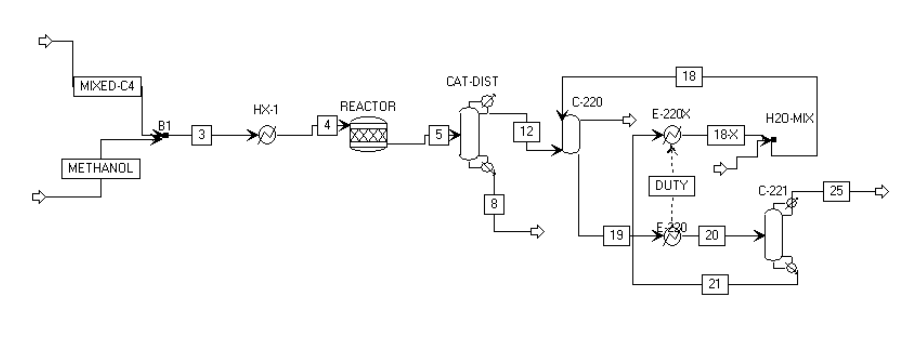
An illustrative example in this project demonstrates the calculation of a make-up water rate for a distillation column. By defining a Balance Block around the relevant unit operations, the system automatically computes the required stream flow rates and conditions, demonstrating the practical utility of this method in industrial process simulation. This approach enhances simulation reliability and provides a robust tool for process evaluation and optimization.
Process Flow Diagarm
Optimization Strategy
The optimization strategy leverages the envelope-based approach of Balance Blocks to maximize simulation efficiency while maintaining accuracy. By including only the relevant unit operations in the envelope, unnecessary calculations are avoided, resulting in faster convergence and lower computational load. This ensures that make-up streams, feed flow rates, and stream conditions are updated consistently and accurately, supporting effective process simulation.
Additionally, Balance Blocks enable process optimization under varying operational conditions. Parameters such as feed rates, recycle fractions, and energy inputs can be adjusted to evaluate their impact on system performance. By integrating operational constraints and maintaining robust material and energy balances, engineers can identify optimal operating conditions while minimizing manual adjustments and design iterations
Envelope Definition and Selection
Defining the envelope correctly is critical for the accuracy and efficiency of Balance Block
calculations. By carefully selecting only the relevant blocks, the Balance Block ensures that
stream updates are limited to the necessary sections of the process, avoiding unnecessary
computation on unrelated unit operations.
Make-Up Stream Calculation
Balance Blocks can automatically calculate the flow rates of make-up streams in recycle
systems. In this project, the make-up water flow to a distillation column is determined
automatically based on the balance of the system, eliminating the need for external calculations or iterative loops.
Feed Stream Adjustment
Feed stream flow rates and conditions can also be determined automatically. This ensures
consistent input streams for the simulation and reduces manual intervention, particularly in
complex flowsheets with multiple interacting unit operations.
Projects Insight
Simplified Recycle Management
● Automatically calculates make-up streams.
● Reduces dependence on Fortran subroutines.
● Improves simulation reliability.
Operational Scenario Analysis
● Evaluates different feed and recycle scenarios.
● Assesses system performance under varying conditions.
● Supports informed process decisions.
Efficient Envelope Calculations
● Only includes selected unit operations.
● Reduces computational overhead.
● Focuses on critical process areas for faster convergence.
Convergence Improvement
● Eliminates iterative design loops.
● Ensures robust and faster convergence.
● Reduces calculation errors.
Automatic Feed Adjustments
● Computes feed flow rates and conditions without manual iteration.
● Ensures consistent steady-state simulation results.
● Minimizes human error in complex systems.
Industrial Application
● Useful for distillation, separation, and recycle operations.
● Applicable to energy and material balance calculations in chemical plants.
● Supports process design, optimization, and scale-up studies.
Conclusion
This project demonstrates the use of Balance Blocks in Aspen Plus as an effective tool for calculating material and energy balances in industrial process simulations. By automatically updating make-up streams and feed conditions within a defined envelope of unit operations, Balance Blocks enhance simulation efficiency, accuracy, and convergence. This methodology reduces manual workload, simplifies complex flowsheets, and supports process optimization
and operational decision-making.