
Effect of Steam on Calcination Reactions in RGibbs Simulations Using Aspen Plus
Project Description
This project focuses on simulating the calcination of calcium carbonate (CaCO₃) into calcium oxide (CaO) and carbon dioxide (CO₂) within the RGibbs reactor model in Aspen Plus. Calcination is a thermochemical process commonly conducted at high temperatures, typically above 900 °C, to drive the decomposition of CaCO₃. However, in RGibbs simulations, the observed reaction temperature can appear lower than the expected industrial conditions due to changes in gas composition and equilibrium constraints. Understanding these deviations is crucial for accurate process modeling and design.
The RGibbs reactor computes chemical equilibrium by minimizing Gibbs free energy. In the presence of water vapor (H₂O) in the gas stream, the partial pressure of CO₂ decreases, which shifts the equilibrium toward product formation even at lower apparent temperatures. This behavior can result in an earlier onset of CaCO₃ decomposition in simulations than expected from typical literature or lab-scale data. The project explores this effect and demonstrates how varying H₂O concentration influences reaction efficiency and equilibrium composition.
A systematic approach is adopted to evaluate the impact of steam on calcination reactions. By adjusting H₂O flow in the feed streams and performing sensitivity analysis, the simulation highlights how temperature and gas composition jointly affect product yields. The study provides insights into industrial-scale calcination processes and supports optimization of reactor operation for maximum CaO production.
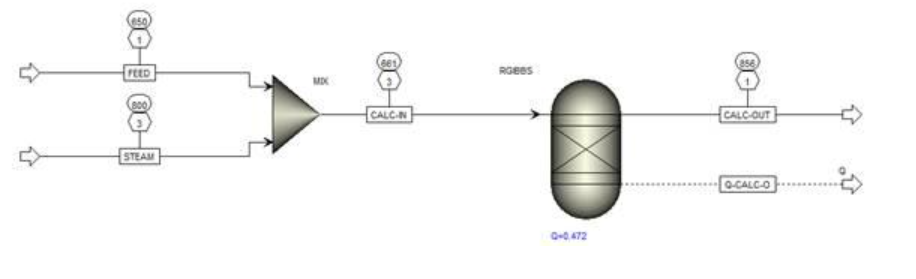
Process Flow Diagarm
Optimization Strategy
The optimization strategy focuses on controlling gas composition, particularly H₂O content, to achieve accurate calcination behavior in RGibbs simulations. By systematically varying the water flow rate in the feed stream, users can observe changes in partial pressure, equilibrium shift, and product formation. This method enables engineers to reconcile simulation results with expected industrial calcination conditions and improve predictive accuracy.
Additionally, sensitivity analysis is employed to assess the combined impact of temperature and steam concentration on the extent of CaCO₃ decomposition. By identifying the optimal H₂O level and reaction temperature, the simulation can accurately replicate desired calcination efficiency while minimizing energy consumption. This approach provides a practical framework for tuning RGibbs models to reflect real-world reactor conditions.
Impact of Steam on Equilibrium
The presence of water vapor in the gas stream reduces the partial pressure of CO₂, shifting the
equilibrium toward product formation at lower temperatures. This effect must be accounted for
when simulating industrial calcination processes to avoid overestimation of reaction efficiency or
misinterpretation of temperature data.
Temperature Sensitivity Analysis
Using sensitivity analysis, the temperature range at which significant CaCO₃ decomposition
occurs can be evaluated. By systematically varying the reactor temperature, users can
determine the minimum operating conditions required to achieve complete calcination under
different steam concentrations.
Feed Stream Adjustment
The H₂O flow in the feed stream is a critical parameter. Adjusting the water content allows the
user to control reaction equilibrium and efficiency. Lowering the H₂O concentration increases the
partial pressure of CO₂, which delays decomposition and ensures that the simulated reaction
matches industrial expectations.
Projects Insight
Steam’s Effect on Reaction Temperature
● Water vapor reduces CO₂ partial pressure.
● Equilibrium shifts toward CaO formation at lower apparent temperatures.
● Accurate modeling requires monitoring H₂O content.
Reactor Performance Evaluation
● Enables assessment of conversion efficiency.
● Evaluates impact of feed variations on product yields.
● Identifies operational limitations in process design.
Sensitivity Analysis for Process Tuning
● Temperature and H₂O flow rates are key variables.
● Helps identify optimal operating conditions.
● Improves correlation between simulation and real-world data.
Industrial Application
● Provides guidance for kiln or rotary calciner operation.
● Helps reduce energy usage by optimizing temperature.
● Ensures consistent CaO production quality.
RGibbs Reactor Utility
● Automatically calculates equilibrium composition.
● Accounts for multi-component interactions.
● Supports predictive modeling of industrial calcination
Process Optimization Considerations
● Balances energy input and product yield.
● Adjusts feed composition for maximum efficiency.
● Provides framework for scale-up and sensitivity studies.
Conclusion
This project demonstrates the impact of steam on the calcination of CaCO₃ in RGibbs simulations using Aspen Plus. By adjusting H₂O content and performing sensitivity analysis, the simulation accurately reflects the equilibrium behavior of calcination reactions under varying conditions. The study highlights the importance of feed composition, temperature control, and equilibrium considerations in achieving reliable predictions for industrial processes, providing engineers with a robust tool for process optimization and reactor design.