
Low-Pressure CO₂ Capture from Syngas in IGCC Systems Using DEPG: Process Simulation, Hydraulic Evaluation, and Economic Assessment in Aspen Plus
Project Description
Integrated Gasification Combined Cycle (IGCC) power plants offer improved efficiency and reduced emissions compared to conventional coal-fired systems. However, large quantities of carbon dioxide (CO₂) are still produced from syngas streams. This project focuses on modeling and optimizing low-pressure CO₂ capture from syngas using Dimethyl Ether of Polyethylene Glycol (DEPG) as a physical solvent within Aspen Plus. The study is designed for an industrial-scale capacity of approximately 1 million tonnes of CO₂ captured per year.
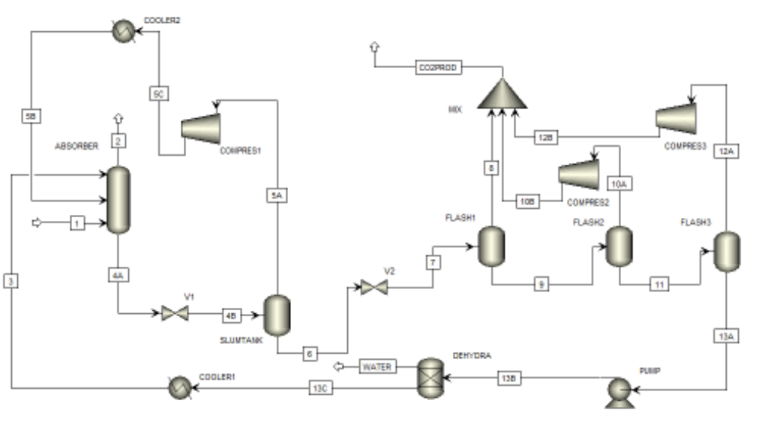
The process utilizes a packed absorber operating at approximately 250 psia, where CO₂ is selectively absorbed from syngas composed mainly of CO₂, H₂, and N₂. The lean DEPG solvent enters from the top of the absorber and flows counter-currently to the syngas feed. The rich solvent leaving the absorber undergoes staged pressure reduction through a turbine and multiple flash drums to regenerate the solvent and release concentrated CO₂. The regenerated solvent is then recycled back to the absorber, ensuring continuous operation.
Thermodynamic properties are modeled using the Perturbed Chain Statistical Association Fluid Theory (PC-SAFT) Equation of State to accurately represent DEPG behavior. A rigorous rate-based column model is applied to simulate mass and heat transfer mechanisms.
Additionally, hydraulic analysis, economic evaluation (CAPEX and OPEX), and CO₂ emission tracking are incorporated, making this model suitable for process optimization, scale-up studies, and sustainability assessment.
Process Flow Diagarm
Optimization Strategy
Optimization of the CO₂ capture system focuses on absorber operating pressure, solvent circulation rate, flash drum pressures, and column packing configuration. Sensitivity analysis is conducted to determine optimal operating conditions that maximize CO₂ removal efficiency while minimizing solvent loss and energy consumption. Particular attention is given to balancing pressure reduction stages to enhance CO₂ recovery without excessive compression or recompression energy penalties.
Economic optimization is performed using Aspen’s integrated economic evaluation tools to assess capital investment and operational costs. Carbon pricing and emission tracking are incorporated to evaluate environmental impact and potential revenue from carbon credits. Hydraulic analysis ensures that column flooding, pressure drop, and packing efficiency remain within safe operational limits, thereby enhancing reliability and long-term performance.
Advanced Physical Solvent-Based CO₂ Capture
DEPG is a well-established physical solvent used in gas processing industries due to its strong
CO₂ solubility under high-pressure conditions. Unlike chemical solvents, physical solvents require less regeneration energy, particularly suitable for high-pressure syngas streams in IGCC applications.
Rigorous Rate-Based Column and Hydraulic Modeling
The absorber is simulated using a rate-based model that accounts for mass transfer coefficients, thermodynamic non-idealities, and packing geometry. Column Analysis tools are used to evaluate internal configuration, diameter sizing, and flooding limits, ensuring realistic industrial-scale design.
Integrated Economic and Emission Assessment
The model incorporates capital and operating cost estimation along with carbon tracking based on global warming potential standards. With approximately 1 million tonnes of CO₂ captured annually, the process demonstrates negative net CO₂ emissions, supporting decarbonization
strategies.
Projects Insight
High Annual CO₂ Capture Capacity
● Approximately 1 million tonnes per year captured
● Suitable for IGCC large-scale plants
● Produces concentrated CO₂ product stream
Low-Pressure Regeneration Strategy
● Multi-stage pressure flashing improves efficiency
● Minimal thermal energy requirement
● Reduced solvent degradation risk
Advanced Thermodynamic Modeling
● PC-SAFT EOS improves property prediction
● Validated against experimental data
● Reliable for high-pressure systems
Hydraulic Performance Validation
● 30-stage packed absorber design
● MELLAPAK 250X packing configuration
● Flooding and pressure drop analysis included
Economic Feasibility Analysis
● CAPEX and OPEX estimation integrated
● Carbon pricing considered in evaluation
● Supports financial decision-making
Environmental Sustainability Impact
● Significant reduction in net CO₂ emissions
● Supports CCUS deployment roadmap
● Aligns with global climate targets
Conclusion
This project presents a comprehensive Aspen Plus simulation of low-pressure CO₂ capture from syngas in IGCC systems using DEPG as a physical solvent. The integration of PC-SAFT thermodynamic modeling, rigorous rate-based column simulation, hydraulic validation, and economic analysis ensures high accuracy and industrial relevance. The model demonstrates that large-scale CO₂ capture with reduced energy penalty is technically and economically feasible. It serves as a strong foundation for further process integration, debottlenecking, and optimization toward sustainable power generation systems