
Energy Efficiency Optimization in an Iron and Steel Coke Plant Using Aspen Plus
Project Description
Iron and steel production is a highly energy-intensive process, with coke production accounting for roughly 10% of the total energy demand. Improving energy efficiency in coke plants is crucial for reducing fossil fuel consumption, operational costs, and carbon emissions. This project models the coke production process using Aspen Plus, including coke oven operation, coke oven gas (COG) quenching, and flue gas heat recovery.
The simulation integrates combustion, quenching, and waste heat recovery to quantify net power generation, consumption, and CO2 emissions. By applying detailed plant-wide modeling, the project identifies areas for energy conservation, highlighting the potential for electricity generation from intermediate-pressure (IP) steam produced during quenching operations.
Ultimately, this study demonstrates how process modeling can provide actionable insights for energy efficiency improvements in the steel industry. It also serves as a foundation for evaluating decarbonization strategies by linking energy performance metrics with CO2 emissions and potential carbon tax implications.
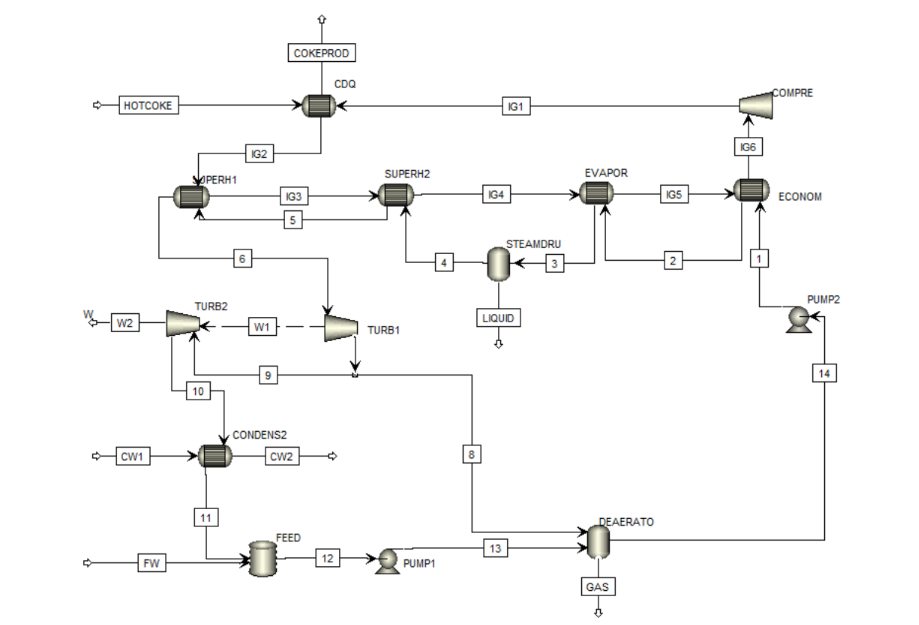
Process Flow Diagarm
Optimization Strategy
Efficient operation of the coke plant requires a holistic approach. First, feed preparation and charging must be optimized to ensure consistent coal quality and coking conditions. Combustion of clean COG in lined combustion chambers ensures efficient heat transfer to the coking chamber while minimizing unburned residues.
Second, quenching strategies, including coke dry quenching (CDQ) and COG quenching, are optimized to recover thermal energy. Recovered heat is used to generate superheated steam for electricity production via IP steam turbines. Continuous monitoring of process parameters, including temperature, flow rates, and steam quality, ensures optimal energy recovery and CO2 reduction.
Projects Insight
Coke Production Process
- Coal mixture is charged into the coke oven and heated to ~1100 °C.
- Combustion of COG transfers heat to the coking chamber efficiently.
- Produces coke, COG, coal tar, crude benzenes, ammonia, sulfur, and water.
Waste Heat Recovery
- Flue gas from combustion chambers is cooled in an economizer.
- Excess heat is captured for low-pressure steam generation.
- Enhances overall plant energy efficiency and reduces losses.
COG Cooling and Cleaning
- Raw COG is cooled and partially cleaned to recover tar, benzene, and sulfur.
- Heat recovery from high-temperature COG preheats feedwater.
- Supports IP steam generation for electricity production.
Energy and Emission Metrics
- Net electricity generation: 158.3 kWh per ton of hot metal.
- CO2 emissions: 0.552 t/h per ton of hot metal.
- Carbon tax implications calculated at $28.14 per hour.
Coke Dry Quenching (CDQ)
- Red-hot coke is cooled using inert gas in a CDQ tower.
- Thermal energy from CDQ is recovered via heat exchangers.
- Recovered heat generates IP steam for turbine-based electricity.
Modeling Approach in Aspen Plus
- RYield reactor models coke yield and product distribution.
- RGibbs reactor simulates COG combustion and energy transfer.
- Process flows and thermal energy balances integrated for accurate energy prediction.
Conclusion
The integrated Aspen Plus simulation of coke production, COG cooling, and coke quenching demonstrates a practical approach to improving energy efficiency in a high-energy section of the iron and steel industry. By capturing waste heat from COG, flue gas, and incandescent coke, the plant can generate substantial electricity while reducing carbon emissions and minimizing environmental impact. The results show that for producing one ton of hot metal, 158.3 kWh of electricity can be generated alongside 0.552 tons of CO2 emissions, highlighting the dual benefit of energy recovery and emission mitigation. This model not only provides a detailed framework for analyzing current energy utilization but also serves as a foundation for future optimization of the entire iron and steel production process. With rising energy costs and stricter carbon regulations, such integrated simulation tools are essential for designing sustainable, low-carbon steelmaking operations and for implementing effective strategies to achieve long-term energy and environmental goals.