
Modeling Electricity Generation from Coal Using Steam Power Cycle in Aspen Plus
Project Description
Coal-fired thermal power plants convert the chemical energy stored in coal into electrical energy through a series of energy transformation steps. The combustion of coal in a boiler releases a large amount of heat, which is used to convert water into high-pressure steam. This steam drives a turbine connected to an electrical generator, producing electricity for industrial and domestic consumption. Despite increasing focus on renewable energy, coal remains a major source of global power generation due to its availability and high energy content.
Modeling electricity generation from coal in Aspen Plus requires special consideration because coal is classified as a non-conventional component. Unlike conventional fluids, coal properties are defined using laboratory ultimate and proximate analysis data. Therefore, before performing combustion equilibrium calculations, coal must first be decomposed into its elemental constituents such as carbon, hydrogen, oxygen, nitrogen, and sulfur.
This project aims to develop a comprehensive Aspen Plus simulation of a coal-based steam power cycle. The model integrates coal decomposition, equilibrium combustion, heat recovery, steam generation, turbine expansion, condensation, and water recycling. The simulation provides detailed predictions of steam production, turbine work output, flue gas composition, and overall plant efficiency, enabling performance evaluation and optimization studies.
Process Flow Diagarm
Optimization Strategy
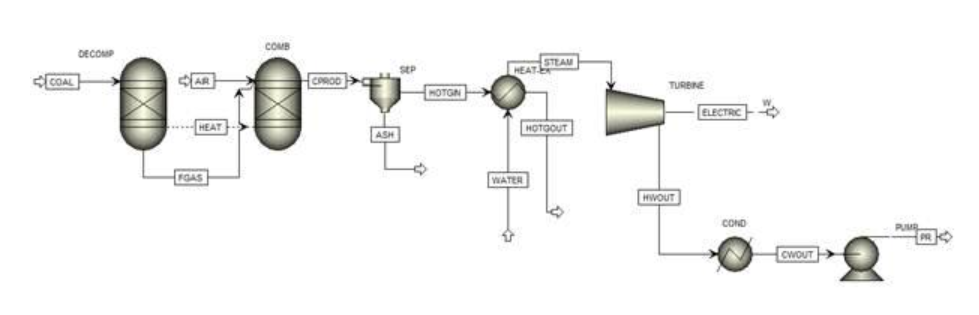
The operational strategy begins with defining coal and ash as non-conventional components and selecting appropriate thermodynamic property models such as PR-BM or RKS-BM. The enthalpy and density of coal are calculated using HCOALGEN and DCOALIGT models. Coal is decomposed in an RYield reactor to convert it into elemental species because Gibbs free energy minimization cannot be directly applied to non-conventional components.
After decomposition, the elemental species react with air in an RGibbs reactor to simulate complete combustion under equilibrium conditions. The heat generated from combustion is transferred to water through a heat exchanger to produce high-pressure steam. The steam expands through a turbine to generate mechanical work, is condensed in a condenser, and thenpumped back to the boiler, forming a closed-loop steam cycle while ash is separated from flue gases.
Projects Insight
Coal Characterization
- Define coal and ash as non-conventional components
- Input ultimate and proximate analysis data
- Assign HCOALGEN and DCOALIGT property models
Steam Generation System
- Use heat exchanger to recover combustion heat
- Convert feedwater into high-pressure steam
- Control steam temperature and pressure
Coal Decomposition (RYield Reactor)
- Convert coal into elemental species
- Disable “Check Atom Balance” option
- Transfer heat stream to combustion block
Turbine Power Generation
- Expand steam in turbine block
- Define turbine efficiency and discharge pressure
- Calculate mechanical work output
Combustion Modeling (RGibbs Reactor)
- Simulate equilibrium combustion with air
- Specify operating pressure and temperature
- Minimize Gibbs free energy for product prediction
Condensation and Water Recycling
- Condense exhaust steam in condenser
- Pump condensate back to boiler pressure
- Maintain continuous closed-loop operation
Conclusion
The Aspen Plus simulation of electricity generation from coal using a steam power cycle provides a complete thermodynamic representation of a conventional coal-fired thermal power plant. By properly defining coal as a non-conventional component and decomposing it into elemental species before equilibrium combustion, the model accurately captures the heat release and flue gas formation during combustion. The integration of decomposition, RGibbs combustion modeling, heat exchange, turbine expansion, condensation, and pumping operations enables detailed energy balance calculations and realistic estimation of power output and efficiency. This structured modeling approach highlights the importance of selecting appropriate thermodynamic property methods and reactor configurations to ensure accurate simulation results. Although the model is based on equilibrium assumptions and does not include kinetic or mechanical losses in full industrial detail, it serves as a strong analytical foundation for system optimization, performance improvement, and environmental impact assessment. Overall, this project demonstrates how Aspen Plus can be effectively used to analyze coal-based electricity generation systems and support the design of more efficient and sustainable thermal power plants.