
Simulation and Analysis of Renewable Biobutanol Production Using ABE Fermentation Technology in Aspen HYSYS
Project Description
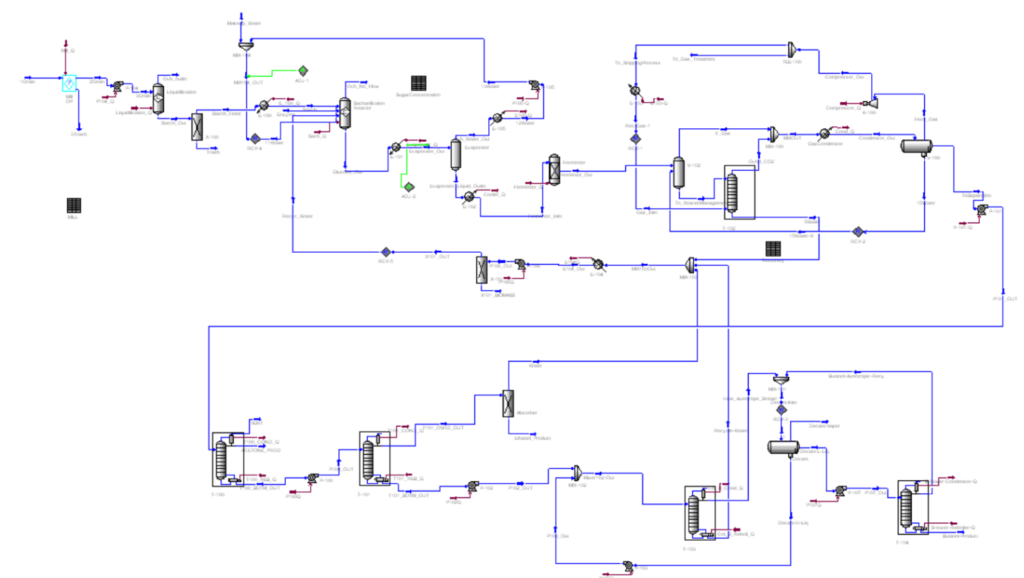
Biobutanol production through Acetone–Butanol–Ethanol (ABE) fermentation is an important renewable energy technology that converts biomass into valuable fuels and industrial chemicals. In this project, a simplified process model is developed in Aspen HYSYS to simulate the production of biobutanol from corn-based biomass through fermentation and separation processes.
The process begins with the milling of corn kernels, where the raw material is prepared for further processing by reducing particle size. The starch present in corn is then converted into fermentable sugars through liquefaction and saccharification processes using simplified conversion reactors. These steps prepare glucose as the main substrate for microbial fermentation.
In the fermentation stage, glucose is converted into acetone, butanol, ethanol, carbon dioxide, and hydrogen using a yield shift reactor. The fermentation broth is then sent to separation units such as distillation and dehydration columns to obtain high-purity products. This simulation demonstrates how Aspen HYSYS can be used to analyze biofuel production systems and evaluate process performance.
Process Flow Diagarm
Optimization Strategy
The modeling strategy involves representing each stage of the ABE fermentation process using Aspen HYSYS unit operations. The milling process is simulated using a user-defined model that represents simple physical conversion and energy requirements. Liquefaction and saccharification are represented using conversion reactors where starch is converted into glucose based on predefined reaction conversions.
The fermentation reactor is modeled using a yield shift reactor where product yields for acetone, butanol, ethanol, and other by-products are specified. After fermentation, downstreamseparation processes such as distillation and dehydration are used to purify the products. These operational strategies allow engineers to evaluate product yield, process efficiency, and system behavior under different operating conditions.
Process Modeling of Biobutanol Production from Corn in Aspen HYSYS
This project focuses on simulating the production of biobutanol using corn as the primary feedstock. The model integrates fermentation reactions and separation units to evaluate product yield and overall process performance.
Aspen HYSYS Simulation of Acetone-Butanol-Ethanol Fermentation Process
This study demonstrates how Aspen HYSYS can be used to model the ABE fermentation process, including biochemical reactions and solvent recovery through distillation systems.
Renewable Biofuel Production through ABE Fermentation Simulation
This project analyzes the conversion of biomass-derived glucose into biofuels using fermentation technology and highlights the importance of process simulation in developing sustainable energy system
Projects Insight
ABE Fermentation Process
- Converts glucose into acetone, butanol, and ethanol
- Uses microorganisms for biochemical conversion
- Produces gases such as hydrogen and carbon dioxide
Fermentation Reactor Modeling
- Yield shift reactor is used in simulation
- Product yields are specified for each component
- Operating temperature and pressure influence conversion
Biomass Feedstock Preparation
- Corn is used as the raw material
- Milling reduces particle size for processing
- Starch is extracted for further reactions
Product Separation Techniques
- Distillation columns purify solvents
- Dehydration improves ethanol concentration
- Azeotropic separation produces high-purity products
Starch Conversion Process
- Liquefaction breaks down starch molecules
- Saccharification converts starch into glucose
- Enzymatic reactions improve sugar yield
Role of Process Simulation
- Helps analyze complex biochemical systems
- Reduces experimental costs in process development
- Supports optimization of industrial biofuel production
Conclusion
The Aspen HYSYS model of the ABE fermentation process provides a simplified representation of biobutanol production from renewable biomass. The simulation integrates fermentation reactions with downstream separation units to produce high-purity biofuel products. By using process simulation tools, engineers can analyze process behavior, evaluate operating conditions, and improve production efficiency. This model serves as a useful foundation for understanding biofuel production and developing more advanced industrial process simulations.