Deploying a Dynamic Model through Aspen OTS Framework
Project Description
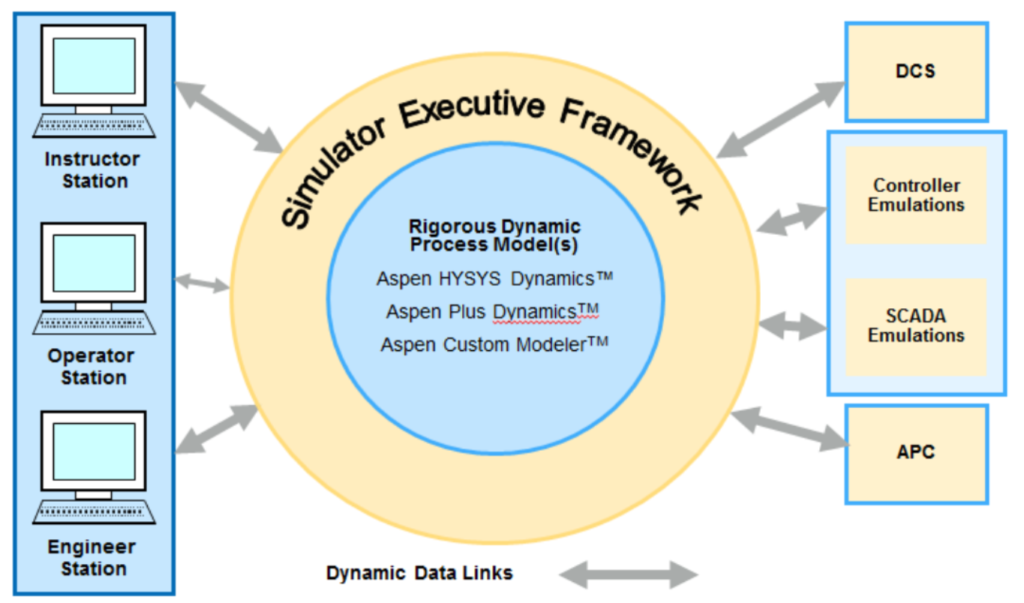
The deployment of a dynamic process model using Aspen OTS Framework enables operators to interact with a highly realistic emulation of the plant and its control systems. This system integrates HYSYS Dynamics, Aspen Plus Dynamics, and Aspen Custom Modeler simulations with operator interfaces, allowing trainees to experience operational scenarios in a risk-free environment. The framework supports parallel processing and partitioned simulations, which ensures real-time execution even for complex systems with fast and slow dynamic responses.
By utilizing the OTS Framework, plants can improve operator efficiency and safety. Operators gain hands-on experience with startup, shutdown, and emergency procedures, and can practice handling abnormal events without impacting production. The system also enhances understanding of control strategies, allowing operators to anticipate process behavior and optimize plant performance.
The OTS model also provides a robust platform for engineers to validate control strategies and simulate plant modifications before implementation. Integration with OPC-compliant devices ensures seamless communication between the simulation and external systems, supporting advanced training, process design verification, and operational optimization across multiple plant scenarios
Process Flow Diagarm
Optimization Strategy
Effective operation of the OTS Framework involves creating accurate partitions, stream connections, and control signal links between dynamic models. By defining step sizes for fast and slow dynamics, operators can simulate compressors, heat exchangers, and reactors realistically. Properly configured partitions ensure stable and accurate real-time simulation while maintaining computational efficiency.
Operators also leverage tag management for monitoring key process variables. Variables can be added through manual selection, copy-paste from HYSYS models, or the Auto-Publish feature. Writing and reading these tags through OPC servers allows integration with external clients, enabling real-time control, scenario analysis, and process optimization, making the training experience both interactive and operationally relevant.
Partitioned Model Setup
Dynamic models are divided into partitions to handle fast and slow process dynamics separately. This approach enables the simulation to run efficiently in real time while maintaining accuracy. Partitioning allows each unit operation to operate with appropriate integration time steps.
Tag Creation and Management
Key process variables are monitored using tags, which can be added through variable selection, copy-paste from simulations, or auto-publishing. Tags provide operators and engineers with a comprehensive view of process behavior and control signals across the plant
OPC Integration for Real-Time Control
The OTS Framework supports OPC-compliant communication for streaming data between models and external clients. This allows real-time monitoring, writing to variables, and executing simulation runs, providing a fully interactive operator training experience.
Projects Insight
Operator Training Benefits
- Realistic plant interface and control emulation.
- Hands-on experience with startup, shutdown, and emergency scenarios.
- Improved operator knowledge and decision-making under stress
Tag Management
- Manual variable selection, copy-paste, or Auto-Publish.
- Tags track pressures, temperatures, and flows.
- Supports external OPC clients for real-time data streaming
Simulation Partitioning
- Separate fast and slow dynamic models for optimized performance.
- Custom integration time steps for accuracy.
- Efficient parallel execution for large-scale simulations.
OPC Server Integration
- Connects simulation data to external applications.
- Allows writing to and reading from simulation variables.
- Supports advanced scenario testing and process optimization.
Control Signal Connections
- Links between control systems across partitions.● Real-time monitoring of process parameters.
- Enables scenario-based training and process validation.
Model Validation and Optimization
- Test control strategies before plant implementation.
- Evaluate process modifications in a risk-free environment.
- Ensure stable and accurate operation of dynamic plant simulations.
Conclusion
Deploying a dynamic model through Aspen OTS Framework provides a comprehensive and interactive platform for operator training, process validation, and operational optimization. By combining real-time dynamic simulation with advanced partitioning, tag management, and OPC integration, this approach enhances operator readiness, improves plant safety, and ensures accurate testing of control strategies before implementation. The system supports both educational and operational objectives, making it an invaluable tool for modern industrial plants.