
Prediction of Low Flammability Limits for Aqueous Solutions Using Aspen Plus Simulation
Project Description
Flammability hazards are a major safety concern in chemical processing industries, particularly when dealing with aqueous solutions containing combustible organic compounds. Determining the low flammability limit (LFL) experimentally for different compositions and temperatures can be time-consuming, expensive, and sometimes hazardous. This project focuses on predicting the low flammability limit for aqueous mixtures using process simulation techniques in Aspen Plus.
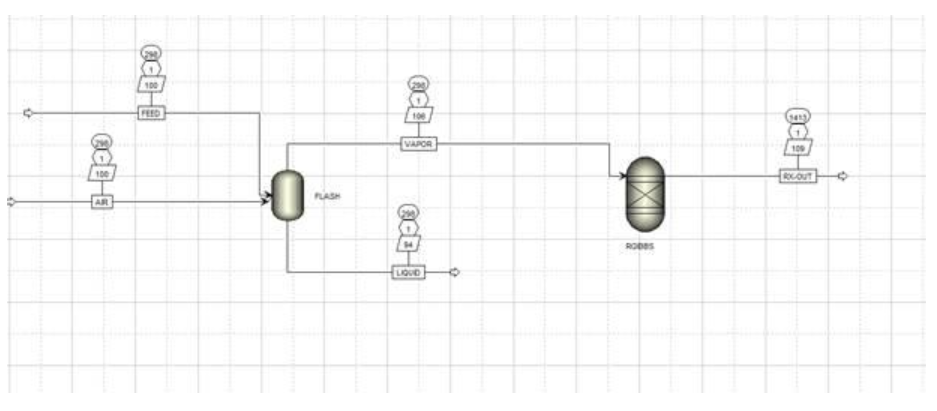
The methodology involves determining the vapor composition that is in equilibrium with the aqueous solution in the presence of air. Once the vapor composition is calculated, the organic components present in the vapor phase are reacted with oxygen to simulate combustion behavior. The simulation determines whether the mixture can sustain combustion based on the predicted adiabatic flame temperature.
The predicted low flammability limit corresponds to the concentration at which the adiabatic flame temperature exceeds approximately 1400 K, indicating that combustion can propagate. This simulation approach allows engineers to evaluate flammability risks over a wide range of operating conditions, enabling safer process design and improved hazard analysis in industrial applications.
Process Flow Diagarm
Optimization Strategy
The operational strategy begins by establishing vapor–liquid equilibrium between the aqueous solution and air using a FLASH unit operation. This step determines the vapor composition that may participate in combustion under equilibrium conditions. The resulting vapor mixture is then sent to a combustion simulation block to analyze its flammability characteristics.
An RGIBBS reactor is used to simulate the adiabatic combustion process by minimizing the Gibbs free energy of the reacting system. Design specifications are applied to control oxygenconsumption and achieve the target flame temperature. Sensitivity analysis is performed by varying the feed temperature or composition to determine the concentration range at which the adiabatic flame temperature exceeds the critical threshold.
Simulation-Based Evaluation of Flammability Limits in Aqueous Chemical Systems
This project demonstrates how Aspen Plus can be used to evaluate flammability risks in aqueous chemical mixtures. By simulating vapor–liquid equilibrium and combustion reactions, the model predicts the concentration range in which the vapor mixture becomes flammable, allowing engineers to assess safety limits without extensive experimental testing.
Process Safety Analysis of Combustible Aqueous Mixtures Using Aspen Plus
This project focuses on analyzing combustion behavior in aqueous solutions containing organic components. The Aspen Plus model integrates equilibrium calculations and adiabatic combustion simulations to determine the lower flammability limit and identify safe operating conditions for chemical processe
Computational Prediction of Combustion Limits for Chemical Process Streams
This project presents a computational method for predicting combustion limits of process streams using Aspen Plus. By combining vapor–liquid equilibrium modeling with Gibbs reactor calculations, the simulation predicts the adiabatic flame temperature and identifies flammability thresholds for industrial safety analysis.
Projects Insight
Importance of Flammability Limit Prediction
- Helps identify safe operating conditions in chemical plants
- Reduces risk of fire and explosion hazards
- Supports process safety and hazard analysis
Role of Design Specifications
- Controls oxygen consumption during combustion
- Maintains required target temperature conditions
- Improves accuracy of the flammability prediction
Vapor–Liquid Equilibrium Modeling
- Determines vapor composition above aqueous solutions
- Provides input composition for combustion analysis
- Accounts for temperature and composition effects
Sensitivity Analysis for LFL Prediction
- Varies temperature and feed composition
- Generates flammability limit curves
- Helps evaluate safe operating ranges
Adiabatic Combustion Modeling
- Uses RGIBBS reactor to simulate combustion reactions
- Calculates equilibrium products and flame temperature
- Determines whether combustion can propagate
Industrial Safety Applications
- Chemical processing facilities
- Storage and handling of flammable liquids
- Explosion prevention and safety system design
Conclusion
This project demonstrates a simulation-based methodology for predicting the low flammability limits of aqueous solutions using Aspen Plus. By combining vapor–liquid equilibrium calculations with adiabatic combustion modeling, the process identifies the concentration at which the vapor mixture becomes capable of sustaining combustion. The use of FLASH and RGIBBS unit operations enables accurate prediction of vapor composition and flame temperature under various operating conditions. Design specifications and sensitivity analysis further enhance the reliability of the simulation by allowing systematic variation of process parameters. This approach provides a practical and efficient tool for evaluating flammability risks, supporting safer chemical process design, and minimizing the need for extensive experimental testing in industrial safety studies.