
Modeling Combining Redistribution in Aspen Plate Fin Heat Exchanger Using Aspen HYSYS and EDR
Project Description
Combining redistribution in a plate fin heat exchanger refers to the process where a stream changes its operating conditions such as temperature, pressure, composition, or flow rate at an intermediate point inside the exchanger core. This usually occurs when a stream mixes with another internal or external stream, or when part of the stream leaves the exchanger for reconditioning and later re-enters the system. Since Aspen EDR cannot directly simulate stream mixing within the exchanger core, integration with Aspen HYSYS becomes necessary for accurate process modeling.
In this project, Aspen HYSYS is used to perform stream splitting, mixing, and reconditioning calculations, while Aspen EDR handles the thermal and hydraulic calculationsoftheplatefinexchanger.Theintegratedsimulationprovidesapractical solution for representing real industrial exchanger operations where streams are redistributed between different layers. This method improves heat transfer analysis, pressure drop calculations, and overall exchanger performance evaluation.
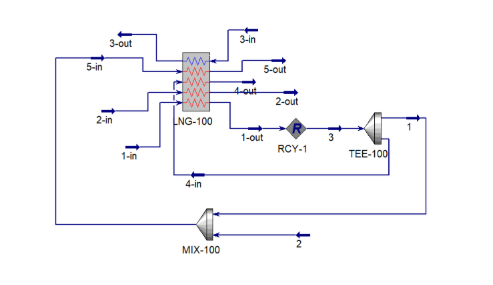
The project focuses on simulating multiple hot and cold streams inside the exchanger core. A portion of the main hot stream remains in its original layer, while another portion mixes with an external stream and enters a different layer. Additional streams are created in Aspen HYSYS to represent the redistribution process. The combined Aspen HYSYS and EDR approach improves simulation flexibility, exchanger design accuracy, and operational efficiency in applications such asLNG processing and cryogenic systems.
Process Flow Diagarm
Optimization Strategy
Efficient operation of combining redistribution systems requires proper coordination between Aspen HYSYS and Aspen EDR. Stream splitting, mixing, and redistribution must be accurately managed tomaintain stable exchanger performance and reliable simulation convergence. Proper operational strategies improve thermal efficiency and ensure balanced flow distribution inside the exchanger core.
The operational methodology also focuses on optimizing heat transfer performance while minimizing pressure drop across exchanger layers. By controlling stream routing andlayer allocation effectively, engineerscan improve exchanger reliability, reduce energy losses, and enhance overall process performance in industrial applications.
Stream Splitting and Redistribution
This strategy involves dividing the main process stream into separate fractions before entering different exchanger layers. One fraction remains in the original layer while the other fraction mixes with another stream and flows into a separate layer. This approach accurately represents real industrial redistribution conditions inside compact heat exchangers.
Aspen HYSYS and EDR Integration
Aspen HYSYS performs stream mixing, reconditioning, and pressure adjustment calculations, while Aspen EDR handles heat transfer and hydraulic analysis. The integration between both software platforms ensures accurate iterative calculations and allows efficient modeling of complex exchanger operations involving combining redistribution.
Thermal and Hydraulic Optimization
This strategy focuses on improving heat transfer efficiency and controlling pressure drop within the exchanger core. Engineers can optimize layer configuration, stream routing, and flow distribution to achieve stable operation and better thermal performance. Proper optimization reduces operational losses and improves exchanger efficiency.
Projects Insight
Understanding Combining Redistribution
- Stream conditions maychange inside the exchanger core.
- Redistribution occurs due to stream mixing or reconditioning.
- Temperature and pressure variations affect exchanger performance.
Role of Aspen HYSYS
- Aspen HYSYS performs stream splitting calculations.
- It manages stream mixing and reconditioning operations.
- HYSYS improves simulation flexibility and convergence.
Role of Aspen EDR
- Aspen EDR calculates heat transfer performance.
- It performs hydraulic and pressure drop analysis.
- EDR models exchanger thermal behavior accurately.
Stream Layer Management
- Stream fractions can flow through different exchanger layers.
- Proper layer allocation improves heat transfer efficiency.
- Balanced flow distribution enhances operational stability.
Industrial Applications
- Used in LNG and cryogenic processing plants.
- Helpful in compact heat exchanger systems.
- Supports energy-efficient thermal process design.
Simulation Advantages
- Improves exchanger design accuracy.
- Reduces operational and energy losses.
- Enhances process reliability and optimization.
Conclusion
The simulation of combining redistribution in Aspen Plate Fin Heat Exchangers using Aspen HYSYS and Aspen EDR provides an effective solution for modeling complex stream mixing and redistribution processes. Aspen HYSYS handles stream splitting, mixing, and reconditioning calculations, while Aspen EDR performs detailed thermal and hydraulic analysis of the exchanger core. This integrated approach improves simulation accuracy, exchanger performance, and operational efficiency in industrial applications such as cryogenic systems, LNG plants, and compact heat exchanger networks.