
Calculation of Water Enthalpy Using Steam Tables Reference State in Aspen Plus
Project Description
This project focuses on calculating the enthalpy of water in Aspen Plus using the ASME Steam Tables reference state. The ASME Steam Tables define the reference point for enthalpy calculations at the triple point of water (0.01 °C and 611.657 Pa), which differs from Aspen Plus’
default reference of an ideal gas at 25 °C and 1 atm. For applications requiring comparison with standard literature values, it is essential to adjust the enthalpy calculations to match the Steam Tables reference.
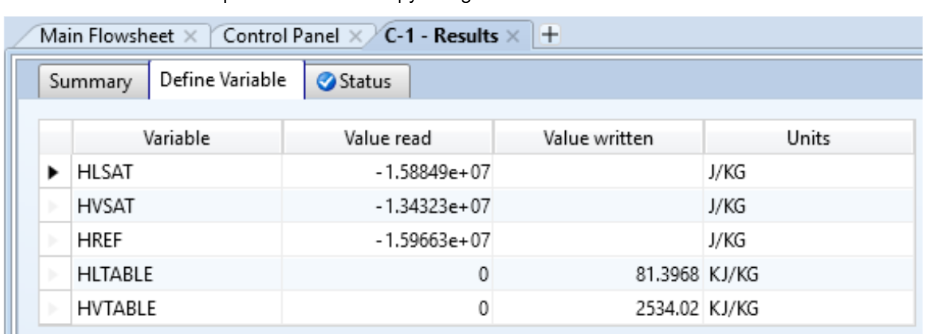
The methodology involves creating separate streams for saturated liquid and saturated vapor at the desired temperature. Aspen Plus property sets are used to retrieve the mass enthalpy of each stream. An additional property set calculates the enthalpy of water at the triple point, which
is then subtracted from the stream enthalpy to align with the ASME reference. This approach ensures that enthalpy values calculated in Aspen Plus are consistent with widely used engineering references.
By integrating a Calculator block, the workflow automates the conversion from Aspen Plus reference to ASME reference enthalpy. The approach can be adapted for any temperature or phase, providing a flexible framework for engineers to evaluate thermodynamic properties in a
manner consistent with standard references. This facilitates accurate energy balance calculations and reliable process design when comparing simulation results to published data.
Optimization Strategy
The optimization strategy focuses on ensuring accurate enthalpy calculations across different phases and temperatures while minimizing manual intervention. By using property sets and a Calculator block, the enthalpy values are automatically adjusted to match the Steam Tables reference state. This reduces potential errors in manual calculations and ensures consistency across multiple streams in the process flowsheet.
Additionally, the model allows sensitivity analysis to assess how variations in temperature and pressure affect the calculated enthalpy. Engineers can quickly evaluate the impact of operational changes on energy balances and system performance, providing a robust tool for process evaluation and optimization.
Saturated Liquid and Vapor Representation
Separate streams are defined for saturated liquid and saturated vapor to capture the
phase-dependent enthalpy accurately. This distinction ensures that both phases can be
compared with ASME Steam Table values without introducing errors from mixed-phase
calculations.
Reference State Adjustment
The enthalpy at the triple point is calculated using a dedicated property set and subtracted from
the Aspen Plus stream enthalpy. This step aligns Aspen Plus calculations with the ASME
reference state, enabling consistent comparisons and energy evaluations.
Calculator Block Integration
A Calculator block is used to automate the subtraction of the triple-point enthalpy from the
stream values. This integration ensures reproducibility, reduces manual calculation errors, and
allows rapid evaluation across multiple streams or process scenarios.
Projects Insight
Importance of Reference State
● ASME Steam Tables use the triple point as reference.
● Aspen Plus default is Ideal Gas @ 25 °C, 1 atm.
● Reference adjustment is required for accurate comparison.
Automation Benefits
● Calculator block automates reference conversion.
● Reduces manual errors and ensures consistency.
● Supports rapid evaluation of multiple streams.
Phase-Specific Enthalpy
● Saturated liquid and vapor must be evaluated separately.
● Mixed-phase calculations can introduce errors.
● Accurate phase representation improves energy balance calculations.
Sensitivity Analysis
● Temperature and pressure variations can be quickly tested.
● Provides insights into process energy requirements.
● Helps optimize operational conditions.
Property Set Utility
● Mass enthalpy can be retrieved directly using “MASSENTH”.
● Triple point enthalpy calculated with “REFERENC”.
● Streamlining property retrieval enhances workflow efficiency.
Industrial Application
● Ensures enthalpy values match published ASME references.
● Supports design, optimization, and benchmarking of thermal systems.
● Useful in energy balance and process simulation studies.
Property Set Utility
● Mass enthalpy can be retrieved directly using “MASSENTH”.
● Triple point enthalpy calculated with “REFERENC”.
● Streamlining property retrieval enhances workflow efficiency.
Industrial Application
● Ensures enthalpy values match published ASME references.
● Supports design, optimization, and benchmarking of thermal systems.
● Useful in energy balance and process simulation studies.
Conclusion
This project demonstrates a practical methodology for calculating water enthalpy in Aspen Plus
using the ASME Steam Tables reference state. By integrating property sets and a Calculator
block, engineers can align Aspen Plus calculations with standard references, ensuring accurate
and consistent energy evaluations. The approach provides a robust framework for process
design, energy balance calculations, and comparison with published data, enhancing the
reliability of simulation-based process studies.