
Data Regression of UNIFAC-PSRK Group Interaction Parameters from VLE Data Using Aspen Plus DRS
Project Description
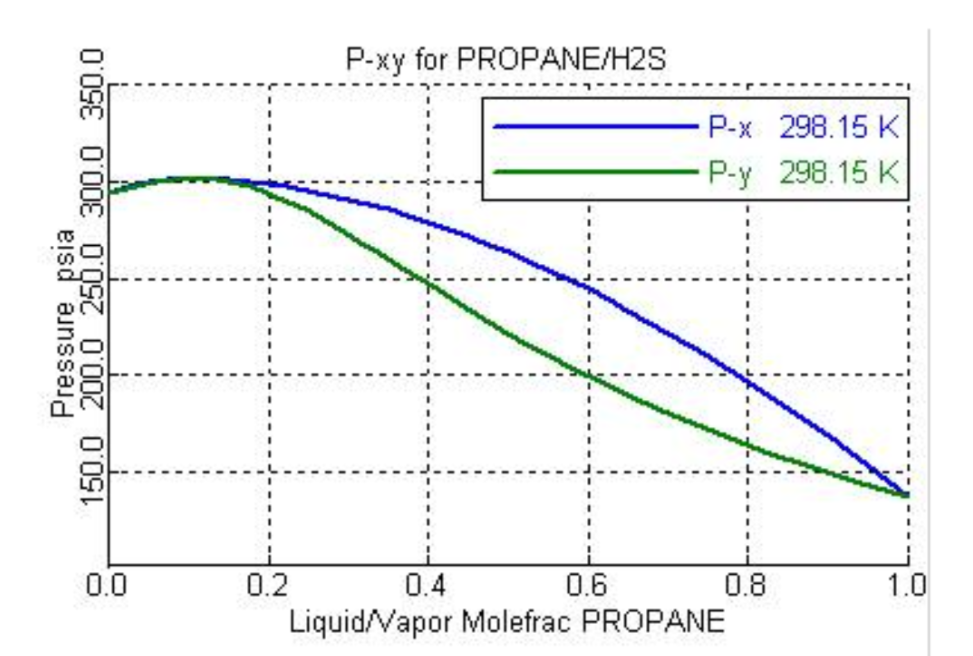
Accurate vapor–liquid equilibrium (VLE) modeling is essential for reliable simulation and design of gas processing and petrochemical systems. This project demonstrates the regression of UNIFAC-PSRK group interaction parameters using experimental VLE data within the Aspen Plus Data Regression System (DRS). The system studied is propane–hydrogen sulfide at 298.15 K, where experimental P-x-y data are used to refine predictive thermodynamic parameters.
The PSRK (Predictive Soave–Redlich–Kwong) equation of state integrates the Soave–Redlich–Kwong (SRK) EOS with UNIFAC group contribution methods to improve mixture parameter estimation. In the UNIFAC-PSRK framework, binary interaction parameters
are defined between main functional groups rather than individual molecules. For this case, regression is performed for the CH₂–H₂S and H₂S–CH₂ group interactions. Because CH₂ and CH₃ belong to the same main group (CHn), their interaction parameters must remain identical, ensuring structural consistency.
Using DRS, the binary interaction parameters are estimated by minimizing deviations between calculated and experimental VLE data. The regressed parameters are automatically assigned to related subgroups within the same main group and stored under the UNIFPS-1 parameter set. The updated parameter set significantly improves the prediction of the P-x-y diagram compared to default parameters.
Optimization Strategy
The optimization strategy involves minimizing the objective function defined as the deviation between experimental and predicted pressures and phase compositions. Nonlinear regression techniques within Aspen Plus DRS adjust UNIFAC-PSRK group interaction parameters to achieve the best statistical fit. Performance indicators such as average absolute deviation (AAD) and residual distribution are used to validate regression quality.
Special attention is given to parameter hierarchy constraints within the UNIFAC-PSRK structure. Since parameters are defined at the main group level, regression of one subgroup interaction (e.g., CH₂–H₂S) automatically applies to all subgroups within the CHn main group (including CH₃). This constraint ensures thermodynamic consistency and prevents over-parameterization, resulting in a physically meaningful and predictive model.
PSRK Thermodynamic Framework
The PSRK equation of state combines cubic EOS methodology with UNIFAC group contribution theory to calculate mixture parameters. It extends UNIFAC functionality to light gases, making it
suitable for hydrocarbon–acid gas systems.
VLE Data Regression Methodology
Experimental P-x-y data at constant temperature (298.15 K) are used for regression. DRS iteratively adjusts binary group parameters to minimize the difference between calculated and
measured phase equilibrium values.
Group Interaction Parameter Consistency
Binary interaction parameters are defined between main groups. Since CH₂ and CH₃ belong to the CHn main group, interaction parameters with H₂S must remain identical for both subgroups, ensuring structural and thermodynamic consistency.
Projects Insight
Importance of Accurate VLE Modeling
● Essential for gas separation design
● Reduces uncertainty in phase predictions
● Supports high-pressure system simulation
Integration of EOS and Group Contribution
● PSRK combines SRK and UNIFAC
● Improves mixture parameter estimation
● Suitable for light gas systems
Main Group Parameter Constraints
● Parameters defined at main group level
● Subgroups inherit identical values
● Prevents inconsistent regression
Propane–Hydrogen Sulfide System
● Non-ideal gas-phase interactions
● Sensitive to binary interaction values
● Relevant for sour gas processing
DRS Optimization Capability
● Nonlinear regression algorithms
● Objective function minimization
● Automatic parameter linking
Industrial Relevance
● Applicable to refinery gas treatment
● Useful in natural gas processing
● Supports thermodynamic model customization
Conclusion
This project demonstrates the regression of UNIFAC-PSRK group interaction parameters from experimental VLE data using Aspen Plus Data Regression System. By integrating cubic equation of state modeling with group contribution theory, the PSRK framework provides
enhanced predictive capability for hydrocarbon–acid gas mixtures. The regression procedure ensures thermodynamic consistency through main-group parameter constraints and significantly improves agreement with experimental P-x-y data. The methodology serves as a valuable tool for refining property models in advanced gas processing and separation applications.