
Design and Simulation of a Thermosiphon Reboiler Using Aspen Shell & Tube Exchanger
Project Description
Thermosiphon reboilers are widely used in chemical and petrochemical industries to supply heat to distillation columns without the need for mechanical pumps. These reboilers operate based on natural circulation, where density differences between liquid and vapor phases generate the required flow through the heat exchanger. This project focuses on the design and simulation of a thermosiphon reboiler using Aspen Shell & Tube Exchanger software.
The design process involves selecting the appropriate exchanger configuration, specifying operating conditions, and defining pressure losses in the thermosiphon piping circuit. In Aspen Shell & Tube Exchanger, the thermosiphon design mode allows engineers to perform calculations based on a fixed circulation flow while considering driving head and pressure losses. This enables accurate estimation of heat transfer performance, fluid flow characteristics, and vapor generation.
Through this simulation, engineers can evaluate the thermal and hydraulic behavior of the reboiler under different operating conditions. The model helps determine exchanger geometry, nozzle sizes, pressure drops, and stability of thermosiphon flow. The results obtained from the simulation provide valuable insights into optimal equipment design and efficient operation of distillation column reboilers.
Process Flow Diagarm
Optimization Strategy
The operational strategy for designing a thermosiphon reboiler begins with preparing the process data and operating conditions in Aspen Shell & Tube Exchanger. The case is configured in Design Mode, where the exchanger type is selected as a Thermosiphon Vaporizer. The pressure at the liquid level inside the distillation column is specified, and the hot side of the exchanger is assigned to the shell side to ensure effective heat transfer between the heating medium and the process fluid.
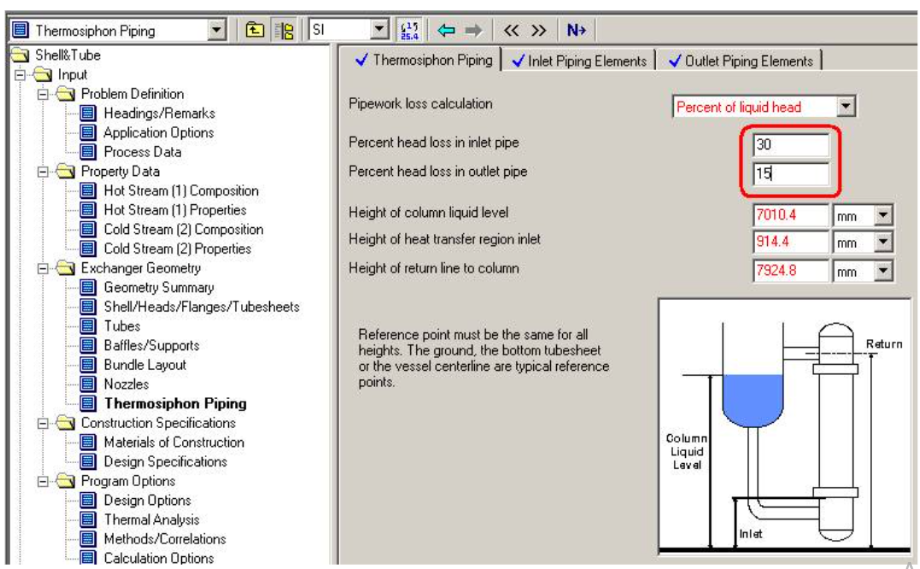
To simulate thermosiphon circulation accurately, pressure losses in the inlet and outlet piping are defined as a percentage of the liquid head. This approach simplifies the design process when detailed piping information is not available. After defining the geometry and operating parameters, the simulation is executed to obtain an optimized heat exchanger design. The software then evaluates thermal performance, pressure drop characteristics, and flow stability to ensure the thermosiphon operates safely and efficiently.
Simulation and Design of Thermosiphon Reboilers for Distillation Systems
This project focuses on the design and simulation of thermosiphon reboilers used in distillation columns. Using Aspen Shell & Tube Exchanger, the study evaluates thermal performance, pressure losses, and circulation behavior to develop an optimized and efficient heat exchanger design.
Heat Exchanger Design for Natural Circulation Reboilers Using Aspen Simulation Tools
This project demonstrates how Aspen Shell & Tube Exchanger can be used to design thermosiphon reboilers operating under natural circulation. The simulation evaluates heat transfer efficiency, hydraulic performance, and operational stability for industrial distillation processes.
Thermal and Hydraulic Analysis of Thermosiphon Reboilers Using Aspen Software
This project presents the thermal and hydraulic analysis of thermosiphon reboilers using Aspen simulation tools. By modeling natural circulation and pressure drop characteristics, the study provides insights into optimal design and improved energy efficiency in distillation systems.
Projects Insight
Thermosiphon Reboiler Principle
- Operates using natural circulation without pumps
- Driven by density differences between liquid and vapor
- Commonly used in distillation columns
Exchanger Geometry Design
- Selection of vertical shell-and-tube configuration
- Tube arrangement affects heat transfer area
- Proper design improves thermal efficiency
Heat Transfer Performance
- Determines efficiency of vapor generation
- Depends on exchanger geometry and fluid properties
- Influences energy consumption of the system
Flow Stability Assessment
- Prevents flow reversal or instability
- Ensures continuous circulation
- Important for safe industrial operation
Pressure Drop Analysis
- Includes losses in piping and exchanger
- Affects thermosiphon circulation rate
- Critical for maintaining stable operation
Industrial Applications
- Petroleum refining distillation units
- Chemical processing plants
- Energy and heat recovery systems
Conclusion
The design of a thermosiphon reboiler using Aspen Shell & Tube Exchanger demonstrates how simulation tools can significantly enhance the efficiency and reliability of heat exchanger systems in chemical processes. By accurately modeling natural circulation, heat transfer, and pressure losses, engineers can develop optimized designs that improve operational stability and energy performance. The use of percentage head loss for piping simplifies early-stage design when detailed piping data is unavailable while still providing reliable results. Additionally, the simulation allows engineers to analyze flow stability, pressure balance, and thermal behavior within the thermosiphon circuit. Such analyses are critical for ensuring safe and efficient operation of distillation columns and other industrial heat transfer systems. Overall, Aspen simulation tools provide a powerful platform for designing thermosiphon reboilers and optimizing heat exchanger performance in modern chemical engineering applications.