
Design and Simulation of a Vertical Thermosiphon Reboiler Using Aspen Shell & Tube Exchanger (Aspen EDR)
Project Description
Thermosiphon reboilers are widely used in refining and petrochemical industries due to their reliability, low maintenance cost, and natural circulation capability. This project focuses on the design and simulation of a vertical thermosiphon reboiler using Aspen Shell & Tube Exchanger (Aspen EDR). The system is designed to vaporize a hydrocarbon mixture (n-pentane and benzene) at a column pressure of 5.13 bar(abs), achieving a vapor mass fraction of 0.4 with a required heat duty of 3,300 kW.
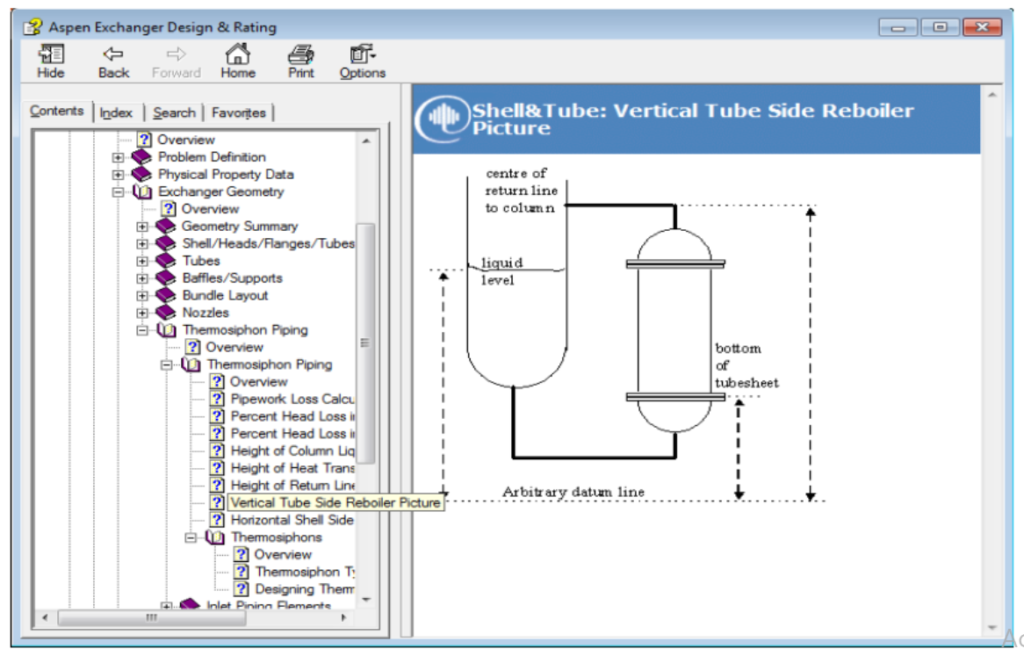
The design phase involves configuring a vertical TEMA AEL exchanger with steam on the shell side and hydrocarbon mixture on the tube side. Key design parameters include tube dimensions (25.4 mm OD, 2.11 mm thickness), fouling resistances, allowable pressure drops, and gravitational liquid head (4 m static head). The thermosiphon effect is driven by density difference and elevation between column liquid level and exchanger inlet, eliminating the need for a circulation pump.
Following the design case, a simulation case is created to evaluate real operational performance with detailed inlet and outlet piping. The thermosiphon simulation iteratively calculates circulation rate and heat load based on static head, piping pressure losses, and two-phase flow behavior. Stability analysis and two-phase flow pattern evaluation ensure that the exchanger operates under stable annular flow conditions while achieving the design vapor fraction and flowrate.
Process Flow Diagarm
Optimization Strategy
The optimization strategy focuses on balancing hydraulic driving force, pressure drop, and heat transfer efficiency to achieve stable natural circulation. The available liquid head must be sufficient to overcome exchanger and piping pressure losses. If excessive circulation occurs, a flow resistance element (e.g., valve) may be introduced to regulate flow and achieve the design vapor fraction of 0.4.
Thermal optimization includes adjusting steam pressure and allowable pressure drop to match the required 3,300 kW duty without oversizing the exchanger. Area ratio evaluation ensures the exchanger is neither undersized nor excessively oversized (ideal area ratio ≈ 1.0). Stability analysis under part-load and clean start-up conditions ensures reliable long-term operation without oscillatory flow behavior.
Thermosiphon Circulation Mechanism
Natural circulation is driven by density differences between inlet liquid and two-phase outlet mixture. The gravitational head created by elevation differences provides the motive force,
eliminating mechanical pumping requirements.
Exchanger Geometry and Hydraulic Design
A vertical TEMA AEL configuration with axial tubeside inlet and cone-type front cover is selected. Tube dimensions and allowable pressure drops are optimized to maximize heat transfer while maintaining circulation stability.
Simulation and Stability Evaluation
Thermosiphon simulation mode incorporates detailed piping elements to calculate actual circulation rates. Stability checks and incremental tube analysis confirm appropriate two-phase
flow regime (preferably annular) at tube outlets.
Projects Insight
Natural Circulation Advantage
● No circulation pump required
● Lower maintenance cost
● Energy-efficient design
Importance of Liquid Head
● 4 m static head drives circulation
● Elevation differences are critical
● Pressure losses must remain within limits
Heat Duty Control
● Steam at 3.5 bar(abs)
● 3,300 kW required duty
● Outlet vapor fraction target = 0.4
Hydraulic Stability Considerations
● Avoid oscillatory two-phase flow
● Monitor outlet vapor fraction
● Validate stability under Flow Analysis
Oversizing and Area Ratio
● Ideal area ratio close to 1.0
● 1.2 indicates oversizing
● Shellside pressure drop adjustment may be required
Operational Flexibility
● Part-load control via shell flooding
● Clean start-up may increase flowrate
● Steam pressure reduction improves stability
Conclusion
This project demonstrates the complete design and operational simulation of a vertical thermosiphon reboiler using Aspen EDR. By integrating thermal design, hydraulic evaluation, and stability analysis, the study ensures reliable natural circulation while achieving the required vaporization duty. The thermosiphon configuration provides a cost-effective and energy-efficient solution compared to forced circulation systems. The developed model supports further studies in part-load performance, start-up stability, and industrial distillation column integration, making it highly relevant for refinery and petrochemical applications.