
Estimation of LMTD, UA, and Heat Recovery in LNG Heat Exchangers Using Aspen HYSYS (Steady-State Analysis)
Project Description
This project explains how Aspen HYSYS estimates key performance parameters such as Log Mean Temperature Difference (LMTD),over all heat transfer coefficient (UA), andheat recovery in an LNG heat exchanger under steady-state conditions. These parameters are essential for evaluating heat exchanger efficiency and energy integration in LNG processes.
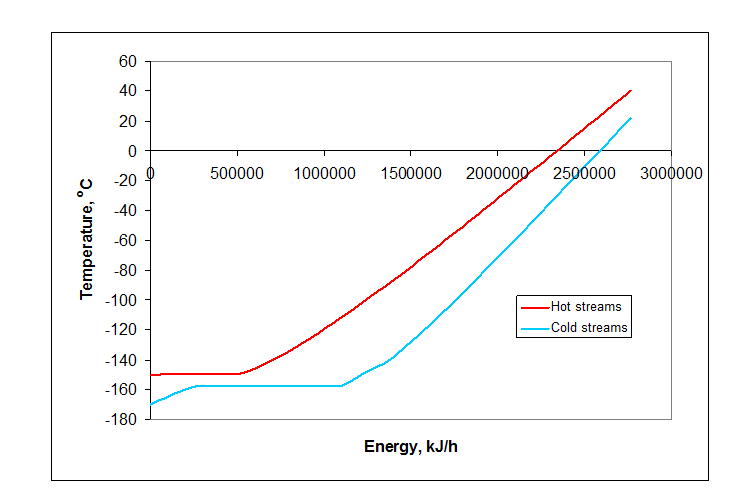
Aspen HYSYS does not calculate LMTD using a simple overall energy balance. Instead, it uses an energy integration approach based on composite curves. The softwarecombinesallhotandcoldstreamsintohotandcoldcompositecurves,splits them into temperature intervals, and calculates heat transfer and LMTD for each interval separately. This segmented approach provides a more accurate representation of real process behavior.
Finally, the overall LMTD and UA values are calculated by summing contributions from all intervals. Heat recovery is also determined based on energy exchanged between hot and cold streams. This method allows Aspen HYSYS to provide a realistic estimation of heat exchanger performance in LNG steady-state simulations.
Process Flow Diagarm
Optimization Strategy
To accurately estimate LMTD, UA, and heat recovery in Aspen HYSYS, proper setup of the LNG heat exchanger network is essential. The first strategy is ensuring that all relevant hot and cold streams are correctly connected to the LNG exchanger. This allows the software to generate accuratecomposite curves for energy integration analysis.
Another important strategy is proper interpretation of interval-based calculations. Since HYSYS divides composite curves into multiple temperature intervals, engineers must understand that LMTD and UA are calculated locally and then combined to form overall results. This ensures better understanding of heat exchanger performance behavior.
Stream Integration Strategy
All hot and cold streams must be properly defined andlinked to the LNG exchanger. This ensures correct formation of composite curves, which are essential for energy integration calculations.
Interval-Based Calculation Strategy
Aspen HYSYS divides composite curves intomultiple intervals for detailed analysis. Each interval has its own LMTD and heat transfer calculation, improving accuracy of overall results.
Performance Interpretation Strategy
Engineers must analyze both interval and overall results carefully. Understanding how UA and LMTD are combined helps in evaluating exchanger efficiency and identifying performance limitations.
Projects Insight
Energy Integration Concept
- Based on composite curve analysis
- Combines multiple hot and cold streams
- Improves heat exchanger design accuracy
LMTD Calculation Method
- Not based on simple energy balance
- Calculated for each temperature interval
- Provides more realistic results
UA Estimation
- Calculated using Q and LMTD per interval
- Represents overall heat transfer capability
- Key parameter in exchanger design
Heat Recovery Analysis
- Based on energy exchanged between streams
- Helps evaluate LNG efficiency
- Important for energy optimization
Role of Composite Curves
- Hot and cold streams are merged separately
- Used to identify heat exchange potential
- Foundation of energy integration method
Industrial Importance
- Used in LNG and cryogenic systems
- Helps optimize energy consumption
- Improves processefficiency and design
Conclusion
In conclusion, Aspen HYSYS estimates LMTD, UA, and heat recovery in LNG heat exchangers using an advanced energy integration approach based on composite curves rather than a simple energy balance. By dividing streams into temperature intervals, the software performs detailed heat transfer calculations that are then combined to produce overall results. This method provides a more accurate and realistic evaluation of heat exchanger performance, making it highly valuable for LNG and energy-intensive industrial applications.