
Estimation of Model Parameters Using Measured Particle Size Distributions in Aspen Plus
Project Description
Particle size distribution (PSD) plays a critical role in many industrial separation and solid-handling processes such as screening, grinding, classification, and filtration. Accurate prediction of particle behavior helps engineers design efficient separation systems and optimize process performance. This project focuses on estimating model parameters in Aspen Plus using experimentally measured particle size distribution data.
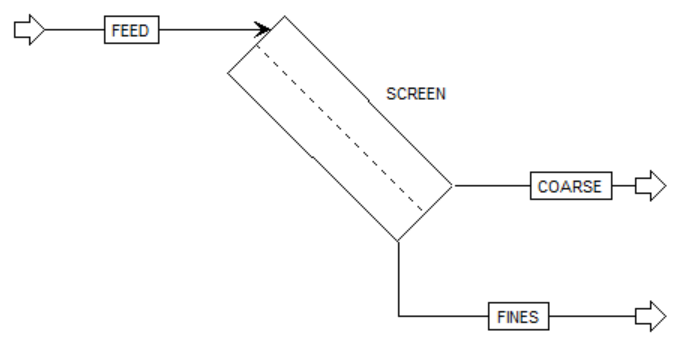
In this simulation, Aspen Plus Data-Fit functionality is used to regress model parameters by comparing measured PSD values with simulation results. The flowsheet is configured to represent a particle separation process where fine and coarse particles are separated based on their size distribution characteristics. By integrating measured PSD data into the model, the simulation can determine parameters such as cut size, sharpness factor, and separation efficiency.
The methodology improves the accuracy of solids processing simulations by aligning theoretical models with real experimental data. Through regression and optimization tools available in Aspen Plus, the process model can be calibrated to represent realistic industrial conditions, making it a valuable tool for process design, troubleshooting, and performance improvement.
Process Flow Diagarm
Optimization Strategy
The operational strategy focuses on integrating measured particle size distribution data into the Aspen Plus simulation environment. Experimental PSD information such as D10, D50, and D90 values is used as input datasets in the Data-Fit tool. These datasets allow the model to compare simulated particle separation results with actual measured values, enabling accurate regression of unknown parameters.
Another key strategy is the adjustment of model parameters including cut size, separation sharpness, and fines offset to match the measured distributions. Aspen Plus regression algorithms iteratively modify these parameters until the simulated particle size distribution closely matches the experimental data. This process ensures that the model accurately reflects real separation behavior.
Particle Separation Modeling and Parameter Estimation Using Aspen Plus
This project focuses on the modeling of particle separation systems and the estimation of key operational parameters using Aspen Plus simulation tools. By incorporating measured particle size distribution data into the model, engineers can accurately determine separation efficiency, cut size, and sharpness factors. The study demonstrates how simulation-based regression techniques can be used to improve the reliability and predictive capability of solid separation process
Simulation and Regression Analysis of Particle Size Distribution in Solid Separation Processes
This project investigates the application of Aspen Plus data regression tools to estimate model parameters based on measured particle size distributions. The simulation framework replicates industrial particle separation operations and adjusts model parameters to align simulation results with experimental measurements. The approach enhances process design accuracy and provides a practical method for optimizing separation performance
Process Modeling of Particle Classification Systems Using Experimental PSD Data
This project explores the integration of experimental particle size distribution data with Aspen Plus simulation models to analyze and improve particle classification systems. Using data regression and parameter estimation techniques, the model identifies critical parameters that influence separation efficiency and product quality. The study provides valuable insights into optimizing industrial particle handling and separation processes.
Projects Insight
Importance of Particle Size Distribution
- Determines efficiency of separation equipment
- Influences product quality and consistency
- Affects downstream processing operations
Sharpness of Separation
- Indicates effectiveness of the classification process
- Higher sharpness results in cleaner separation
- Helps evaluate performance of screening equipment
Data Regression in Aspen Plus
- Uses experimental data to estimate unknown parameters
- Improves model accuracy and reliability
- Enables realistic simulation of industrial systems
Process Optimization Using Simulation
- Reduces the need for costly experimental trials● Allows engineers to perform sensitivity studies
- Improves operational efficiency of separation units
Cut Size Determination
- Defines the separation boundary between fine and coarse particles
- Influences separation efficiency of screening units
- Important for optimizing product specifications
Industrial Applications
- Mineral processing and mining industries
- Powder processing and chemical manufacturing
- Pharmaceutical and food processing systems
Conclusion
This project demonstrates the application of Aspen Plus simulation tools to estimate model parameters using measured particle size distribution data. By integrating experimental PSD datasets with regression techniques, the simulation model can accurately determine parameters such as cut size, separation sharpness, and fines offset. The use of Aspen Plus Data-Fit functionality allows engineers to align theoretical models with real process behavior, improving the reliability and predictive capability of the simulation. The approach provides a powerful method for analyzing particle separation systems, optimizing operational conditions, and enhancing process efficiency in industrial solids handling applications. Through proper modeling and parameter estimation, engineers can design more efficient separation processes, reduce operational costs, and ensure consistent product quality across a wide range of industrial applications.