
Evaluation of Low Heating Value for Non-Conventional Biomass Components
Project Description
The growing interest in renewable energy sources has intensified the need to evaluate the combustion characteristics of non-conventional (NC) components, such as biomass, waste-derived fuels, and industrial byproducts. Accurately determining the low heating value (LHV) of these components is crucial for process design, energy efficiency analysis, and emission control in thermal systems.
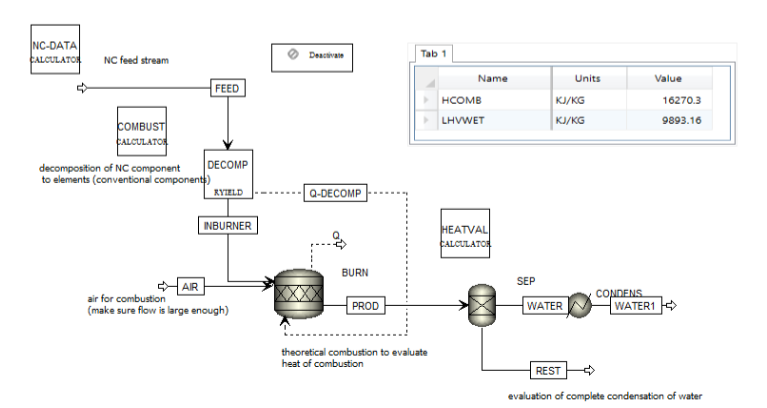
This project focuses on using Aspen Plus to simulate and evaluate the heat of combustion for NC components. The approach leverages calculator blocks and a combination of decomposition and combustion modules to convert complex biomass compositions into conventional species, allowing for precise thermal evaluation. The flowsheet demonstrates how to incorporate ultimate, proximate, and sulfur analysis to predict the energy content effectively.
Through systematic conversion of NC components, calculation of high heating value (HHV), and adjustment for moisture content, the low heating value on a wet basis (LHVWET) is determined. This value reflects practical conditions in energy systems where combustion water is not condensed, providing a realistic basis for process optimization and design.
Process Flow Diagarm
Optimization Strategy
Effective evaluation of the low heating value for NC components requires careful attention to the simulation setup and operational considerations. First, proper characterization of the feedstock is essential; ultimate, proximate, and sulfur analyses must be accurately inputted into the NC-DATA calculator block, which can be simplified through Excel integration. Second, decomposition and combustion must be sequentially applied using DECOMP Ryield and BURN Rstoic blocks, ensuring complete conversion and correct heat release calculation. Third, the HEATVAL calculator block is used to determine both HHV and LHV, with attention to water correction for realistic wet-basis values.
Operational strategies also include iterative validation of the HCOMB values for non-conventional components against standard databank values and adjusting calculator parameters (HCOALGEN codes) to refine the accuracy of the low heating value. These steps ensure robust process modeling and reliable energy evaluation for NC fuels under practical conditions.
Projects Insight
Feedstock Characterization
- Accurate ultimate/proximate/sulfur analysis is essential.
- Data entry is simplified using the NC-DATA calculator block with Excel integration.
- Moisture content must be considered to correct for wet-basis calculations.
Calculation of Low Heating Value (LHV)
- HEATVAL calculator block evaluates LHV on wet basis (LHVWET).
- Corrects HHV for moisture and water heat of condensation.
- Provides realistic value for thermal process design.
Decomposition of NC Components
- DECOMP Ryield block converts NC components to conventional species.
- COMB calculator block calculates decomposition yields.
- Ensures proper representation of biomass for combustion
HCOMB Parameterization
- HCOALGEN option codes allow user-defined or estimated HHV.
- Code 6 enables direct HCOMB input for NC components.
- Ensures alignment with experimental or literature data.
Combustion Modeling
- BURN Rstoic block simulates complete combustion.
- Supports calculation of gross heat release (HHV).
- Accounts for elemental composition and energy balance.
Validation and Reporting
- Compare back-calculated values with standard databank references.
- Identify discrepancies due to formation enthalpy differences.
- Report LHVWET and HHV for engineering design purposes.
Conclusion
The aerobic batch fermentation process for 1,4-Butanediol production integrates controlled microbial growth, regulated substrate feeding, and optimized oxygen mass transfer to achieve high product yield and operational stability. By enhancing kLa and aligning substrate supply with metabolic demand, the process improves conversion efficiency while minimizing impurityformation. Implementation of structured control strategies ensures reproducible batch performance and industrial scalability. Collectively, the optimized framework strengthens the feasibility of renewable BDO production and supports sustainable chemical manufacturing advancement.