
Evaluation of Thermodynamic and Transport Properties of Aqueous Nitric Acid Using Aspen Properties and Excel Add-In
Project Description
Accurate physical-property modeling of aqueous nitric acid is essential for reliable simulation and design of nitric acid production plants and other chemical processes involving strong acids. Nitric acid forms an electrolyte system in water, where ionization significantly influences phase behavior, thermodynamic properties, and transport properties. Therefore, precise representation of this system is critical for vapor-liquid equilibrium calculations, energy balances, and equipment design.
This project evaluates the Aspen Properties electrolyte model for the aqueous nitric acid system. The chemistry considered in the model is based on the dissociation reaction: HNO₃ + H₂O ⇌ H₃O⁺ + NO₃⁻. Model parameters are fitted to experimental data to ensure accurate predictions of vapor-liquid equilibrium, density, heat capacity, excess enthalpy, viscosity, and thermal conductivity.
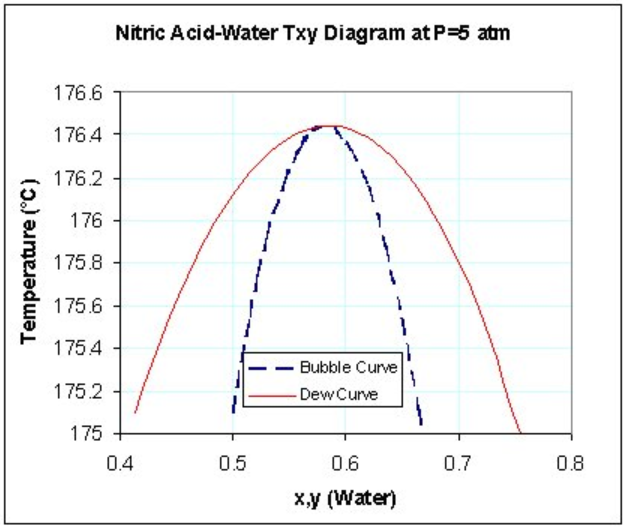
The Excel Add-In for Aspen Properties is used as a powerful analytical tool to generate property tables, Txy and Pxy diagrams, and compare model predictions with experimental data. Special attention is given to behavior near the azeotropic region, where accurate thermodynamic modeling is particularly important for industrial separation and concentration processes.
Process Flow Diagarm
Optimization Strategy
The evaluation strategy begins with selecting the appropriate Aspen Properties electrolyte model for aqueous nitric acid and defining the dissociation chemistry. The model parameters are applied to calculate phase equilibrium and thermodynamic properties across a wide concentration and temperature range. Vapor-liquid equilibrium at 1 atm is analyzed, particularly near the azeotropic composition, where accurate prediction is essential for process reliability.
The Excel Add-In for Aspen Properties is then used to generate graphical comparisons between model predictions and experimental data. Properties such as density, excess enthalpy, heat capacity, viscosity, and thermal conductivity are evaluated systematically. The add-in enables sensitivity analysis and visualization of Txy and Pxy diagrams to study phase behavior in detail and verify the robustness of the model.
Projects Insight
Electrolyte Chemistry Modeling
- Nitric acid dissociates into hydronium and nitrate ions
- Ionization significantly affects thermodynamic properties
- Electrolyte capability improves mid-composition accuracy
Heat Capacity and Excess Enthalpy
- Accurate excess enthalpy correlation
- Reliable liquid heat capacity prediction
- Essential for energy balance calculations
Vapor-Liquid Equilibrium (VLE)
- Accurate prediction at 1 atmosphere pressure
- Reliable modeling near azeotropic composition
- Minor discrepancies at high acid concentrations
Transport Properties
- Captures viscosity maximum at mid-composition
- Thermal conductivity correlated with temperature variation
- Adequate accuracy for most process simulations
Liquid Density Prediction
- Good agreement with experimental data at 25°C
- Reliable across broad concentration range
- Suitable for process mass and volume calculations
Excel Add-In Applications
- Generates Txy and Pxy diagrams
- Allows property sensitivity analysis
- Facilitates comparison with experimental data
Conclusion
The evaluation of the aqueous nitric acid system using Aspen Properties demonstrates that the electrolyte-based physical-property model provides a highly accurate representation of both thermodynamic and transport properties. The incorporation of nitric acid dissociation chemistry enables precise modeling of vapor-liquid equilibrium behavior, particularly near the azeotropic region, which is critical for industrial nitric acid production and concentration processes. The model shows strong agreement with experimental data for density, excess enthalpy, and heat capacity, while also offering reasonable predictions for viscosity and thermal conductivity. The Excel Add-In for Aspen Properties proves to be a valuable analytical tool, allowing detailed visualization of Txy and Pxy diagrams, sensitivity analysis, and direct comparison between calculated and experimental data. Although minor discrepancies exist at very high acid concentrations, the overall performance of the model is sufficiently accurate for engineering design, simulation, and process optimization. Therefore, the Aspen Properties model for aqueous nitric acid can be confidently used in process calculations and integrated into broader engineering simulations within the Aspen Engineering Suite for reliable plant design and operation.