
Impact of Physical Property Model Uncertainty on Amine Regenerator Simulation Using Aspen Plus
Project Description
Amine regeneration systems are critical units in gas sweetening processes, particularly for removing acid gases such as hydrogen sulfide (H₂S) from aqueous amine solutions. This project evaluates the impact of thermodynamic model selection on the simulation results of an amine regenerator column using Aspen Plus. Two property methods are compared: the Kent–Eisenberg model (AMINES) and the Electrolyte NRTL model (ELECNRTL) with KEDEA parameters. Both simulations maintain identical feed conditions and column specifications, including a condenser temperature of 45°C and 93.5% H₂S recovery in the distillate.
Despite producing identical product compositions, the two property methods predict significantly different condenser duties, reboiler duties, reflux ratios, and boil-up rates. The discrepancies highlight the sensitivity of regenerator performance to vapor-liquid equilibrium (VLE) modeling, especially at low acid gas concentrations. The ELECNRTL model predicts higher partial pressures of H₂S at low loadings, leading to easier stripping and lower energy requirements compared to the AMINES model.
To better understand simulation uncertainty, the regenerator was re-specified using reflux ratio instead of H₂S recovery. Sensitivity analysis revealed that when reflux ratio is fixed, the predicted condenser and reboiler duties from both models differ by less than 2%. This confirms that energy duty discrepancies primarily stem from differences in VLE predictions at low H₂S concentrations rather than from other thermodynamic properties such as enthalpy or heat capacity.
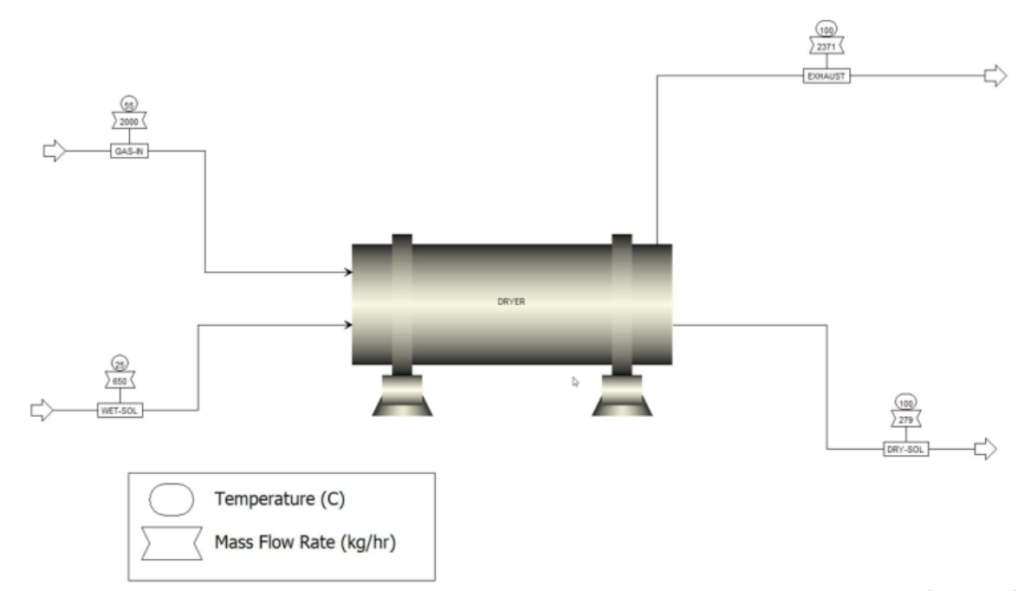
Process Flow Diagarm
Optimization Strategy
The recommended optimization approach is to specify reflux ratio rather than acid gas recovery as the primary design variable. Since VLE predictions at low H₂S concentrations carry significant uncertainty (potentially a factor of two), fixing recovery artificially forces the model to compensate through large changes in energy duties and reflux rates.
A robust optimization framework includes sensitivity analysis on reflux ratio, reboiler duty, and H₂S recovery to define an operational envelope rather than a single deterministic design point. Incorporating safety margins in energy design and validating VLE predictions against experimental data improves reliability. Where possible, rate-based (mass-transfer limited) modeling should be applied to reflect real industrial column behavior.
Thermodynamic Model Comparison
Two property methods were evaluated:
Kent–Eisenberg (AMINES)
Electrolyte NRTL (ELECNRTL with KEDEA parameters)
Both models reasonably fit experimental absorption data, but ELECNRTL shows slightly better agreement at low H₂S concentrations.
Vapor–Liquid Equilibrium Sensitivity
The dominant source of uncertainty is H₂S absorption in aqueous DEA at low loadings. Small variations in predicted equilibrium partial pressures significantly affect stripping efficiency and required energy duty.
Simulation Design-Spec Analysis
When H₂S recovery is fixed, predicted duties vary dramatically between property models. When reflux ratio is fixed, energy duties converge, and recovery becomes the uncertain variable.
Projects Insight
Energy Duty Discrepancy
Up to 41% difference in condenser duty
Reboiler duty differs by nearly 29%
Driven primarily by VLE differences
Low Acid Gas Concentration Effect
Regenerators operate at very low H₂S mole fractions
Experimental data are limited and scattered
Uncertainty may reach a factor of two
VLE Dominance Over Other Properties
Enthalpy and Cp differences are small
H₂S loading is low, minimizing thermal property impact
Absorption equilibrium drives column behavior
Reflux Ratio as a Stable Design Variable
Enthalpy and Cp differences are small
H₂S loading is low, minimizing thermal property impact
Absorption equilibrium drives column behavior
Mass-Transfer Limitations
Real columns are rate-based, not equilibrium-based
Additional uncertainty in practical recovery
Equilibrium simulations may overpredict separation
Industrial Design Implications
Avoid over-specifying acid gas recovery
Include operational safety margins
Validate models with plant data when possible
Conclusion
This study demonstrates that physical property uncertainty—particularly vapor-liquid equilibrium modeling of H₂S absorption—has a significant impact on amine regenerator simulation results in Aspen Plus. While energy duties can vary substantially when acid gas recovery is specified, fixing reflux ratio greatly reduces discrepancies between property methods. The largest uncertainty lies in predicting H₂S recovery at low concentrations, where experimental data are limited and scattered. For reliable industrial design, reflux ratio should be used as the primary specification, and recovery predictions should be treated with caution, especially given additional real-world mass-transfer limitations.