
Industrial-Scale Simulation and Optimization of CO₂ Capture from Natural Gas Flue Gas Using CESAR1 Solvent in Aspen Plus
Project Description
Carbon capture from flue gas is an essential technology for reducing greenhouse gas emissions and achieving global climate targets. This project focuses on the development and simulation of an industrial-scale post-combustion CO₂ capture process using CESAR1 solvent in Aspen Plus. CESAR1 is a second-generation non-proprietary amine blend composed of approximately 27 wt% 2-amino-2-methyl-1-propanol (AMP) and 13 wt% piperazine (PZ), which offers improved performance and reduced operational cost compared to conventional solvents.
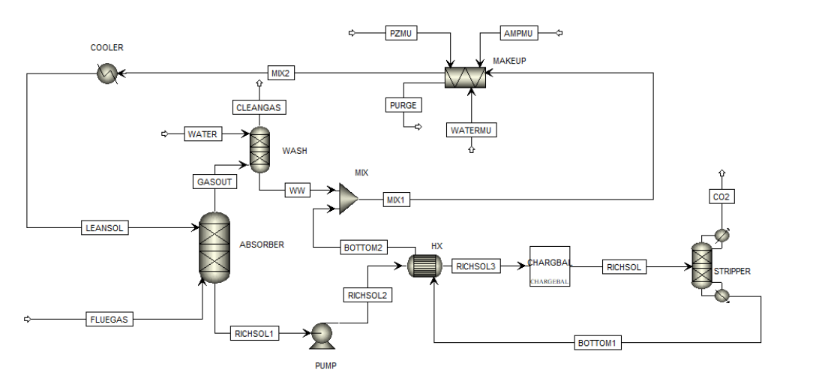
The process treats natural gas-based flue gas containing approximately 3.9% CO₂ using a packed absorber–stripper configuration. Flue gas enters the absorber from the bottom, where CO₂ is chemically absorbed by the lean CESAR1 solvent flowing counter-currently from the top. A water wash section is included to minimize solvent losses. The CO₂-rich solvent is preheated and sent to the stripper, where thermal regeneration releases high-purity CO₂ and regenerates the lean solvent for recycling back to the absorber.
The simulation employs the Electrolyte NRTL thermodynamic model combined with kinetic reaction mechanisms to accurately represent chemical absorption behavior. Rate-based column modeling is used for both absorber and stripper to capture mass transfer, reaction kinetics, and hydraulic effects. The model is validated against pilot plant data and includes economic analysis and CO₂ emission tracking, making it suitable for large-scale process design, optimization, and environmental evaluation.
Process Flow Diagarm
Optimization Strategy
Process optimization was performed by evaluating key operating parameters such as liquid-to-gas ratio, absorber packing height, solvent concentration, and stripper reboiler duty. Sensitivity analysis was used to achieve the desired CO₂ capture efficiency (90–98%) while minimizing energy consumption. Particular attention was given to balancing solvent circulation rate and thermal requirements to reduce the specific reboiler duty.
Additional optimization focused on improving column hydraulics and reducing solvent losses through effective water wash operation. Economic analysis was integrated to assess capital and operating costs, while carbon tracking was used to evaluate environmental performance. These strategies ensured optimal system efficiency with reduced operational cost and lower net CO₂ emissions.
Advanced Solvent-Based Carbon Capture System
The CESAR1 solvent system combines the high absorption capacity of AMP with the fast reaction kinetics of piperazine, enabling efficient CO₂ removal from low-concentration flue gas streams and improving overall process performance.
Rate-Based Absorber and Stripper Modeling
Both columns are simulated using rigorous rate-based models that account for mass transfer resistance, reaction kinetics, and hydraulic limitations, providing accurate predictions for industrial-scale design and operation.
Environmental and Economic Performance Evaluation
The model integrates cost estimation and carbon emission analysis to evaluate process feasibility. Large-scale CO₂ recovery significantly reduces net emissions while supporting carbon pricing and sustainability strategies.
Projects Insight
High CO₂ Capture Efficiency
● Achieves 90–98% CO₂ removal
● Suitable for low-concentration flue gas
● Produces high-purity CO₂ stream
Improved Solvent Performance
● CESAR1 offers faster kinetics than conventional amines
● Lower energy requirement for regeneration
● Reduced solvent degradation and loss
Energy Consumption Management
● Reboiler duty is the major operating cost factor
● Heat integration improves thermal efficiency
● Optimized solvent flow reduces steam demand
Process Validation and Reliability
● Model validated with pilot plant data
● Accurate prediction of CO₂ loading and removal
● Suitable for scale-up and industrial application
Column Hydraulic Optimization
● Packing selection enhances mass transfer
● Hydraulic analysis prevents flooding and operational issues
● Supports stable long-term operation
Environmental Impact Reduction
● Captures approximately 1 million tonnes CO₂ per year
● Results in negative net CO₂ emissions
● Supports CCUS and carbon neutrality goals
Conclusion
This project presents a rigorous Aspen Plus simulation of industrial-scale CO₂ capture from natural gas flue gas using the CESAR1 solvent system. The combination of advanced thermodynamic modeling, kinetic reaction mechanisms, and rate-based column simulation provides accurate prediction of process performance and energy requirements. Validation with pilot plant data, along with integrated economic and emission analysis, demonstrates the feasibility of CESAR1 for commercial deployment. The developed model serves as a reliable foundation for process optimization, scale-up, and sustainable carbon capture system design.