
Modeling and Simulation of Line Heaters in Aspen HYSYS
Project Description
Line heaters are widely used in gas processing systems to prevent hydrate formation and maintain gas temperature during pressure reduction processes. In Aspen HYSYS, line heaters can be modeled using pipe segments, Pipesys extension, heat exchangers, or heater operations depending on the simulation objectives. In this project, the line heater is modeled using pipe segment operations because the heat duty distribution between the preheat and post heat sections is unknown and must be calculated dynamically.
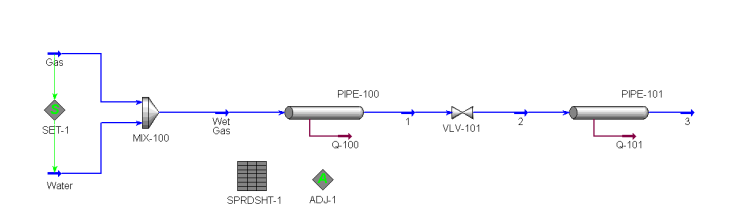
The system consists of two pipe segments representing the preheat and post heat sections along with a choke valve placed between them. Gas flows through the preheat section, passes through the choke where a large pressure drop occurs, and then enters the post heat section. The heater bath contains hot water maintained at a fixed temperature, while the total heat duty supplied to the bath remains constant. Aspen HYSYS calculates the heat transfer between the gas and the surrounding bath using water velocity as an adjustable parameter.
The project also includes the use of spreadsheets and adjust operations in Aspen HYSYS to maintain the required total heat duty of 3 MMBTU/hr. The simulation helps analyze gas temperatures before and after the choke valve and predicts hydrate formation conditions under different gas flow rates. This approach improves understanding of heat transfer behavior, pressure drop effects, and operational performance of line heaters in gas processing applications.
Process Flow Diagarm
Optimization Strategy
Efficient operation of a line heater system requires proper heat transfer control and accurate pressure management throughout the gas flow path. The simulation focuses on maintaining stable heating conditions before and after the choke valve while ensuring that the total heat duty supplied to the bath remains constant. Proper operational strategies help prevent hydrate formation and improve process safety.
The operational methodology also involves adjusting water velocity around the pipe segments to control heat transfer between the gas and the heating bath. By maintaining balanced heating conditions in both the preheat and post heat sections, the system achieves improved temperature stability and efficient line heater performance during varying gas flow conditions.
Pipe Segment Heat Transfer Modeling
This strategy uses pipe segment operations to represent the preheat and post heat sections of the line heater. Heat transfer occurs between the gas flowing inside the pipe and the surrounding heated water bath. Accurate pipe dimensions and heat transfer settings improve simulation reliability and temperature prediction accuracy.
Choke Valve Pressure Control
The choke valve is placed between the two pipe sections and operates with a fixed pressure drop of 1500 psi. The pressure reduction causes a significant temperature decrease in the gas stream, making hydrate analysis important. Proper pressure control helps evaluate gas temperature behavior after the choke valve.
Spreadsheet and Adjust Integration
Aspen HYSYS uses spreadsheet and adjust operations to maintain the totalheat duty supplied to the heater bath. The spreadsheet calculates the total duty from both pipe sections and adjusts water velocity accordingly. This method ensures stable heat transfer conditionsand accurate simulation convergence.
Projects Insight
Importance of Line Heaters
- Line heaters prevent hydrate formation in gas systems.
- They maintain gas temperature during pressure reduction.
- Line heaters improve operational safety and reliability.
Pipe Segment Modeling
- Pipe segments simulate preheat and post heat sections.
- Accurate pipe dimensions improve simulation results.
- Heat transfer calculations depend on surrounding fluid conditions.
Choke Valve Behavior
- The choke valve creates a large pressure drop.
- Pressure reduction lowers gas temperature significantly.
- Temperature analysis after the choke is critical for hydrate studies.
Heat Transfer Control
- Water bath temperature remains fixed during operation.
- Water velocity affects heat transfer efficiency.
- Balanced heating improves gas temperature stability.
Aspen HYSYS Features
- HYSYS uses spreadsheets for duty calculations.
- Adjust operations maintain target heat duty automatically.
- Case studies help analyze different operating conditions.
Industrial Applications
- Used in natural gas processing facilities.
- Important in pipeline pressure reduction systems.
- Supports hydrate prevention and thermal analysis operations.
Conclusion
The modeling of line heaters in Aspen HYSYS using pipe segment operations provides an effective approach for analyzing gas heating and hydrate prevention systems. The integration of pipe segments, choke valves, spreadsheets, and adjust operations allows accurate simulation of heat transfer and pressure drop behavior within the system. This method improves operational analysis, temperature prediction, and process safety in natural gas processing and pipeline applications.