
Modeling Internal Dividing Redistribution in Aspen Plate Fin Heat Exchanger
Project Description
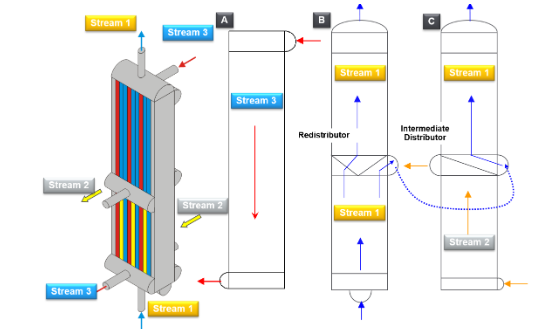
Internal dividing redistribution in a plate fin heat exchanger occurs when a stream initially flowing through one set of layers is divided into two separate flow paths within the exchanger core.This situation commonly arises when another stream exits the exchanger at an intermediate location, leaving certain layers empty. To utilize the empty space efficiently, part of anotherstream is redirected into thevacantlayers through redistributors and intermediate distributors.
In Aspen Plate Fin Exchanger modeling, internal dividing redistribution is used to maintain efficient heat transfer and proper layer utilization throughout the exchanger core. The process involves diverting a portion of a stream from one layer set into another set of layers after a second stream leaves the exchanger. This redistribution improves thermal performance and prevents sections of the exchanger from remaining unused during operation.
The project focuses on simulating the redistribution of a hot stream into empty layers after another hot stream exits the exchanger. Aspen EDR is used to model the heat transfer and hydraulic behavior of the exchanger, while redistribution elements such as redistributors and intermediate distribute orsmanage the flow division between layers. This simulation approach improves exchange trefficiency, stream distribution, and operational flexibility in compact heat exchanger systems.
Process Flow Diagarm
Optimization Strategy
Efficient operation ofinternal dividing redistribution systems requires proper stream routing and balanced flow distribution inside the exchanger core. The redistribution process must ensure that empty layers are effectively occupied without disturbing the thermal and hydraulic performance of the exchanger. Proper operational planning improves exchanger utilization and overall process efficiency.
The operational strategy also focuses on maintaining stable pressure drop and heat transfer conditions while dividing stream flow between multiple layer sets. By controlling redistributor performance and intermediate layer distribution, engineers can achieve better thermal balance, efficient flow allocation, and improved exchanger reliability in industrial operations.
Stream Diversion and Redistribution
This strategy involves diverting a fraction of a stream from one set of layers into another set after an existing stream exits the exchanger. Redistributors are used to split the flow and occupy the empty layers effectively. This approach maximizes exchanger core utilization and improves heat transfer performance.
Intermediate Distributor Management
Intermediate distributors are installed in the empty layer regions to guide the diverted stream into the vacant layers. Proper distributor design ensures smooth flow transition, balanced stream allocation, and reduced hydraulic losses during redistributionoperations inside the exchanger core.
Thermal and Hydraulic Optimization
This strategy focuses on optimizing heat transfer efficiency and minimizing pressure drop after redistribution occurs. Engineers analyze flow behavior, stream allocation, and layer performance to improve exchanger stability and operational efficiency. Proper optimization enhances compact exchanger performance and energy utilization.
Projects Insight
Understanding Internal Dividing Redistribution
- A stream is divided into two layer paths inside the exchanger.
- Redistribution occurs when another stream exits the exchanger.
- Empty layers are occupied by diverted stream flow.
Role of Redistributors
- Redistributors divide stream flow between layers.
- They help maintain balanced flow distribution.
- Proper redistributor design improves exchanger performance.
Importance of Intermediate Distributors
- Intermediate distributors guide flow into empty layers.
- They ensure smooth stream transition between sections.
- Proper distribution reduces hydraulic disturbances.
Thermal Performance Improvement
- Redistribution improves heat transfer efficiency.
- Empty layer utilization enhances exchanger operation.
- Balanced flow improves thermal stability.
Hydraulic Flow Management
- Pressure drop must remain stable after redistribution.
- Flow allocation affects exchanger hydraulic behavior.
- Proper routing minimizes operational losses.
Industrial Applications
- Used in compact plate fin heat exchangers.
- Important in LNG and cryogenic systems.
- Supports advanced heat recovery operations.
Conclusion
The modeling of internal dividing redistribution in Aspen Plate Fin Heat Exchangers provides an effective method for improving exchanger layer utilization and thermal performance. By using redistributors and intermediate distributors, stream flow can be efficiently divided and redirected into empty layers after another stream exits the exchanger. This approach enhances heat transfer efficiency, maintains hydraulic stability, and improves operational flexibility in compact heat exchanger applications such as LNG processing and cryogenic systems.