
Modeling Power Consumption of Agitated Vessels Using Aspen Plus
Project Description
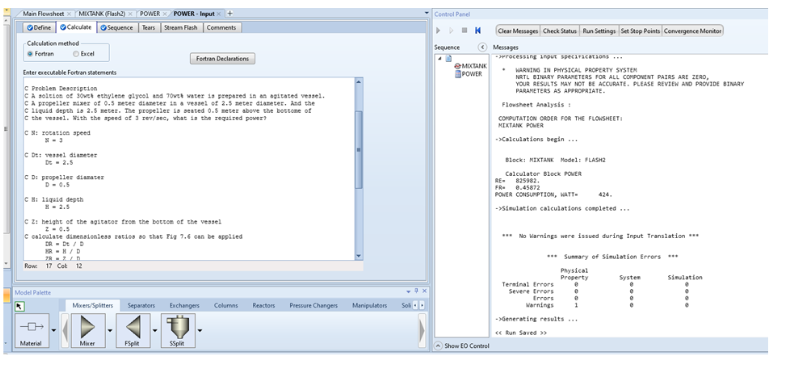
This project focuses on modeling and estimating power consumption for agitated vessels, such as stirred tank reactors, within Aspen Plus. Agitated vessels are widely used in chemical, biochemical, and pharmaceutical processes to enhance mixing, improve heat and mass
transfer, and ensure homogeneity. Accurate estimation of the power required for agitation is critical for energy management, equipment sizing, and process optimization.
Aspen Plus does not natively calculate electrical power consumption for stirrers or agitated reactors. To address this limitation, the project develops a methodology using Calculator blocks to implement correlations that estimate the power draw based on fluid properties, agitator
characteristics, and operating conditions. The approach leverages Aspen Plus property calculations to provide inputs for the correlation, ensuring that the results are physically consistent and can be integrated with the broader process model.
The example methodology demonstrates the calculation framework for different types of agitators and varying fluid conditions. By adjusting empirical or semi-empirical correlations, engineers can adapt the model to specific process requirements. This integrated approach provides a practical means to predict power consumption, supporting process design, energy assessment, and cost estimation for industrial operations.
Optimization Strategy
The optimization strategy focuses on minimizing energy consumption while maintaining adequate mixing and mass transfer in the vessel. By systematically varying agitator speed, impeller type, and fluid properties within the Calculator block correlation, the model identifies conditions that achieve target mixing efficiency at the lowest power requirement. This provides a cost-effective and energy-efficient design approach for stirred tanks. Furthermore, the correlations can be adapted to include process-specific parameters, such as viscosity variations, non-Newtonian behavior, or temperature-dependent density changes. Sensitivity analysis is conducted to evaluate how changes in operating conditions affect power consumption, enabling engineers to optimize reactor performance while controlling energy usage.
Agitator Power Correlation
Power consumption is calculated using correlations that depend on impeller geometry, rotational speed, and fluid characteristics such as density and viscosity. The Calculator block in Aspen Plus integrates these correlations into the simulation, enabling real-time evaluation of power requirements during process simulations.
Integration with Aspen Plus Process Models
The Calculator block methodology allows seamless integration of power consumption
calculations with overall process simulations. Power estimates can be combined with material
and energy balances to assess total plant energy requirements and perform cost analysis.
Industrial Relevance and Applications
The methodology enables engineers to predict power consumption in agitated vessels without
external software or manual calculations. This supports design decisions for mixing equipment,
energy efficiency evaluation, and operational planning in chemical, pharmaceutical, and food
processing industries.
Projects Insight
Limitation of Aspen Plus
● Power consumption is not natively calculated for agitated vessels.
● Requires external correlations implemented in Calculator blocks.
● Provides flexibility but needs user-defined correlations.
Integration Benefits
● Calculator block allows real-time evaluation within Aspen Plus.
● Supports combined process-energy analysis.
● Enables sensitivity and optimization studies
Importance of Fluid Properties
● Density and viscosity significantly affect power draw.
● Non-Newtonian fluids require modified correlations.
● Temperature and concentration influence calculation accuracy.
Optimization Strategy
● Systematic variation of speed and impeller type identifies optimal conditions.
● Reduces operational energy consumption.
● Supports energy-efficient design practices.
Agitator Design Factors
● Impeller type and size affect power consumption.
● Rotational speed is a major variable.
● Proper selection minimizes energy use while ensuring mixing.
Industrial Application
● Applicable to chemical, biochemical, and pharmaceutical stirred tank processes.
● Enhances process design and operational planning.
● Provides accurate power estimates for energy budgeting.
Conclusion
This project demonstrates a practical approach to estimating power consumption in agitated vessels using Aspen Plus, despite the software’s native limitations. By integrating user-defined correlations in Calculator blocks, engineers can calculate electrical power requirements based on fluid properties and agitator specifications. The methodology supports process design, optimization, and energy efficiency assessment, providing a valuable tool for industrial operations involving stirred tanks and agitated reactors.