
Multicomponent Azeotrope Analysis Using Aspen Plus Distillation Synthesis
Project Description
This project investigates the capability of Aspen Plus to model and analyze azeotropes involving more than three components. Azeotropes present significant challenges in separation processes because they exhibit vapor and liquid compositions that are identical at equilibrium, making conventional distillation ineffective. While binary and ternary azeotropes are commonly studied, industrial mixtures often involve more complex multicomponent systems that require advanced thermodynamic modeling and synthesis tools.
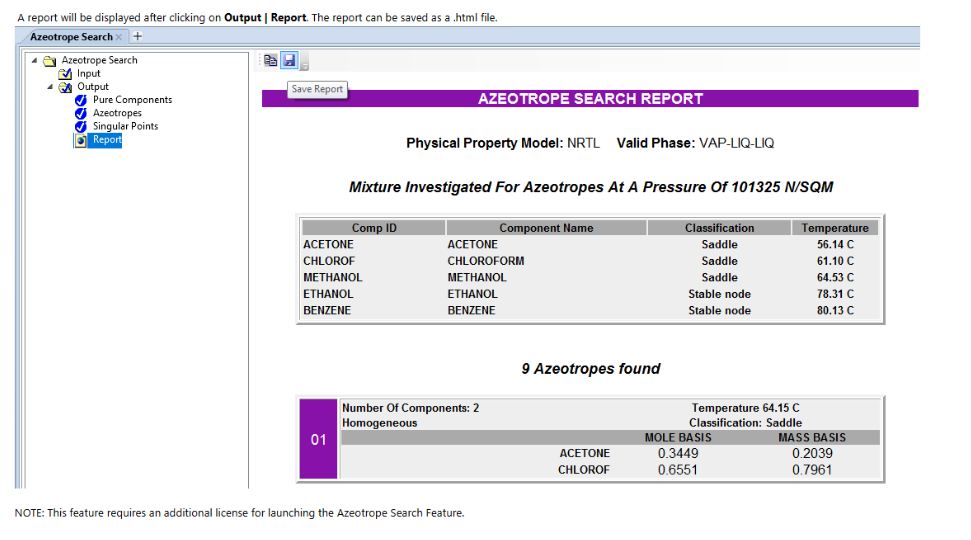
The study demonstrates that Aspen Plus can successfully handle azeotropes with four or more components using the Distillation Synthesis environment. A representative system consisting of acetone, chloroform, methanol, ethanol, and benzene is used as a case study. This mixture is known to exhibit multiple azeotropes, including a quaternary azeotrope, making it suitable for evaluating the robustness of Aspen Plus phase equilibrium modeling capabilities. By defining the selected components and applying appropriate thermodynamic property methods, Aspen Plus generates phase equilibrium data and identifies azeotropic compositions
within the multicomponent system. The analysis supports process engineers in understanding separation boundaries, evaluating feasibility of conventional distillation, and designing alternative separation strategies such as extractive or pressure-swing distillation.
Optimization Strategy
The optimization strategy focuses on accurate thermodynamic representation and systematic exploration of the phase envelope. Selecting an appropriate property method—such as NRTL or UNIQUAC—is critical for predicting non-ideal liquid-phase behavior and identifying azeotropic compositions. The Distillation Synthesis tool is then used to automatically search for azeotropes
across the defined composition space, enabling reliable detection of binary, ternary, and quaternary azeotropes.
To enhance process design, sensitivity analysis can be performed by varying temperature and pressure conditions to evaluate how azeotropic compositions shift under different operating parameters. This allows engineers to determine whether pressure-swing distillation or alternative separation techniques can break the azeotrope. The approach improves feasibility assessment and supports optimization of separation sequences in complex chemical systems.
Multicomponent Phase Equilibrium Modeling
Aspen Plus enables detailed vapor-liquid equilibrium (VLE) calculations for systems containing more than three components. By accurately representing intermolecular interactions, the software predicts azeotropic compositions and critical behavior within highly non-ideal mixtures, supporting advanced separation analysis.
Distillation Synthesis Application
The Distillation Synthesis environment automates azeotrope detection by scanning composition
space and identifying equilibrium pinch points. This functionality significantly reduces manual
trial-and-error calculations and enhances reliability in multicomponent system design.
Industrial Separation Challenges
Multicomponent azeotropes complicate separation processes by limiting achievable purity
through simple distillation. Identifying these azeotropes early in process design allows engineers
to implement alternative strategies such as entrainer selection, extractive distillation, or hybrid
separation systems.
Projects Insight
Capability of Aspen Plus
● Supports azeotrope detection beyond ternary systems.
● Handles quaternary and higher-order mixtures.
● Integrates advanced thermodynamic models for accuracy
Pressure and Temperature Influence
● Azeotropic composition may shift with pressure changes.
● Pressure-swing techniques can break some azeotropes.
● Sensitivity analysis supports feasibility evaluation.
Importance of Property Methods
● Non-ideal systems require activity coefficient models.
● Accurate VLE prediction depends on parameter selection.
● Model validation improves reliability of results.
Process Design Implications
● Early azeotrope detection avoids costly redesign.
● Supports entrainer and solvent selection.
● Improves overall separation efficiency planning
Distillation Limitations
● Azeotropes prevent complete separation via simple distillation.
● Pinch points define separation boundaries.
● Requires alternative process strategies.
Engineering Decision Support
● Provides quantitative composition predictions.
● Enables comparison of multiple separation routes.
● Reduces uncertainty in complex mixture design.
Conclusion
This project demonstrates that Aspen Plus is fully capable of handling azeotropes involving
more than three components through its Distillation Synthesis environment. By applying
appropriate thermodynamic models and systematic phase equilibrium analysis, engineers can
identify multicomponent azeotropes and evaluate their impact on separation design. The
methodology supports advanced process optimization, improves feasibility assessment, and
enhances decision-making for complex industrial distillation systems.