
Process Simulation and Optimization of CO₂ and H₂S Removal from Natural Gas Using Potassium Carbonate (K₂CO₃) in Aspen Plus
Project Description
The removal of acid gases such as carbon dioxide (CO₂) and hydrogen sulfide (H₂S) is a critical step in natural gas processing to meet environmental regulations and product quality specifications. This project focuses on the simulation of a large-scale natural gas sweetening process using potassium carbonate (K₂CO₃) solvent in Aspen Plus for a processing capacity of 1 million tons per year. The study supports carbon capture initiatives and contributes to cleaner energy production.
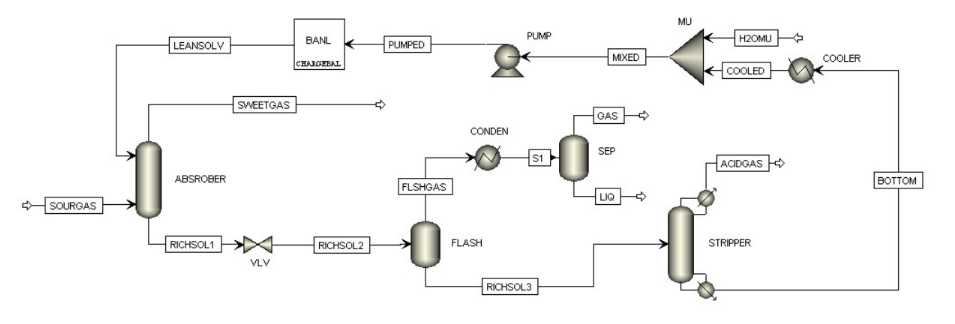
The process consists of an absorber–stripper system where sour natural gas is contacted with lean K₂CO₃ solution in a packed absorption column. Acid gases are chemically absorbed into the solvent, producing purified sweet gas at the top of the column. The rich solvent is then depressurized, flashed, and regenerated in a stripping column where CO₂ and H₂S are removed and collected for further handling or storage. The regenerated lean solvent is recycled back to the absorber.
The simulation uses the Electrolyte NRTL thermodynamic model to accurately represent electrolyte behavior and chemical reactions in the liquid phase. A rate-based column model is applied to capture mass and heat transfer effects, providing realistic performance prediction. The developed model also includes hydraulic analysis, economic evaluation, and CO₂ emission tracking, making it suitable for process design, optimization, and environmental assessment.
Process Flow Diagarm
Optimization Strategy
Optimization of the process was carried out by analyzing key operating parameters such as solvent circulation rate, absorber pressure, column staging, and stripper reboiler duty. Sensitivity analysis helped identify optimal conditions that maximize acid gas removal efficiency while minimizing energy consumption and solvent losses. The objective was to achieve high gas purity with reduced operational costs.
Further optimization focused on improving column hydraulics and thermal efficiency. Rate-based modeling allowed evaluation of packing performance and mass transfer limitations, while economic analysis provided insights into CAPEX and OPEX trade-offs. Carbon emission tracking was also used to assess environmental performance and support decision making for sustainable operation.
Acid Gas Absorption System Design
The absorber column is designed with packed internals to provide efficient contact between sour gas and lean solvent. Counter-current flow enhances mass transfer, allowing effective removal of CO₂ and H₂S while maintaining stable hydraulic performance under high processing capacity.
Solvent Regeneration and Recovery
The rich solvent from the absorber is regenerated through pressure reduction, flashing, and thermal stripping. The stripper removes absorbed acid gases using reboiler heat, restoring solvent strength for reuse and reducing chemical consumption and operating cost.
Environmental and Economic Evaluation
The model integrates economic analysis and carbon emission reporting to evaluate process feasibility. Captured CO₂ streams and reduced net emissions support CCUS objectives, while cost estimation helps optimize operating conditions for industrial implementation.
Projects Insight
High Removal Efficiency
● Effective reduction of CO₂ and H₂S concentrations
● Production of pipeline-quality natural gas
● Stable performance at large processing capacity
Advanced Thermodynamic Modeling
● Electrolyte NRTL ensures accurate electrolyte behavior
● Reliable prediction of absorption reactions
● Suitable for complex acid gas systems
Energy Optimization Potential
● Reboiler duty significantly affects operating cost
● Heat integration improves thermal efficiency
● Optimized solvent flow reduces energy demand
Column Performance Analysis
● Hydraulic evaluation ensures safe operation
● Packing selection improves mass transfer
● Supports scale-up and design validation
Carbon Capture Benefits
● Significant CO₂ recovery from process streams
● Supports CCUS implementation
● Reduces overall greenhouse gas emissions
Industrial Application Readiness
● Suitable for large-scale gas processing plants
● Useful for debottlenecking and expansion studies
● Provides a strong base for advanced process optimization
Conclusion
This project successfully developed a rigorous Aspen Plus model for CO₂ and H₂S removal using potassium carbonate for large-scale natural gas treatment. The rate-based absorption system, combined with Electrolyte NRTL thermodynamics, provides accurate prediction of process performance, energy requirements, and solvent behavior. The integration of hydraulic analysis, economic evaluation, and carbon emission tracking makes the model a valuable tool for industrial design, optimization, and sustainable operation in modern gas processing and carbon capture applications.