
Simulation of Biomass Drying Operations Using Aspen Plus
Project Description
Biomass drying is a critical pre-treatment step in bioenergy, gasification, pyrolysis, and combustion processes. Moisture reduction improves thermal efficiency, reduces transportation costs, enhances combustion stability, and increases overall process performance. This project demonstrates how to simulate biomass drying operations using Aspen Plus, with biomass defined as a non-conventional (NC) solid and modeled using appropriate solid property methods.
In this simulation framework, biomass is characterized using proximate and ultimate analysis data. The SOLIDS property method is selected for handling non-conventional materials, as it provides suitable thermodynamic correlations for coal and biomass-type materials. The biomass feed stream is modeled using the MIXNCPSD stream class to represent non-conventional particulate solids with particle size distribution (PSD).
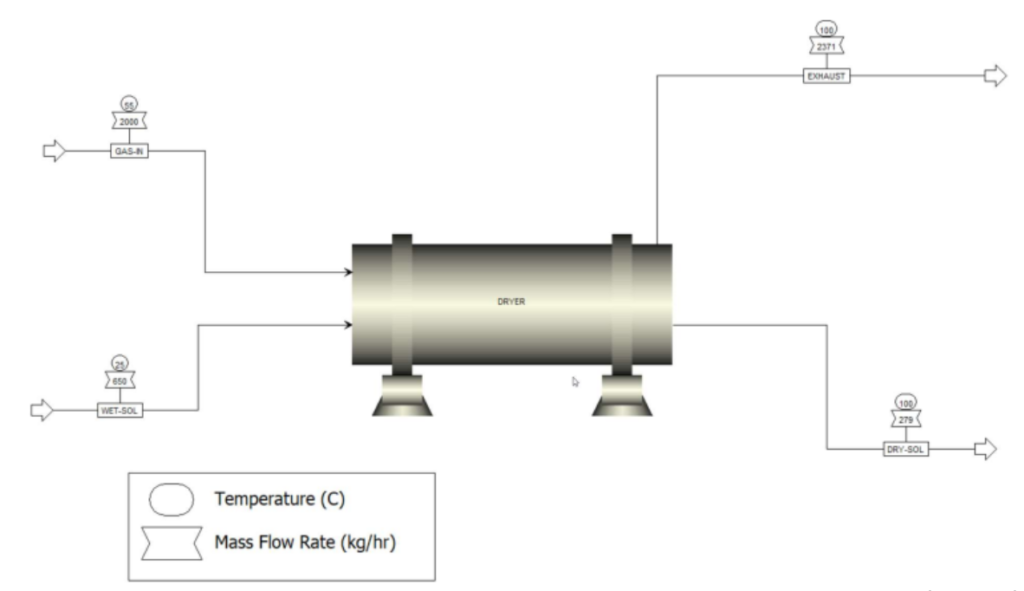
The drying system is modeled as a direct-contact dryer with supplemental warm air feed. Free moisture and inherent moisture are accounted for through mixed and non-conventional solid substreams. The drying operation removes moisture through evaporation, reducing biomass water content and improving downstream energy conversion performance.
Process Flow Diagarm
Optimization Strategy
The optimization strategy focuses on achieving the desired outlet moisture content with minimal energy consumption. Key operating parameters include dryer temperature, air flow rate, residence time, and particle size distribution. Sensitivity analysis can be performed on inlet air temperature, air-to-solid ratio, and initial moisture content to determine optimal drying performance.
Energy efficiency is optimized by balancing heat supply with evaporation duty. Excessive air flow increases energy consumption, while insufficient air limits drying efficiency. Proper control of temperature and air-to-solid ratio ensures stable drying operation with minimal thermal losses and improved process economics.
Advanced Modeling of Biomass Thermal Pre-Treatment Systems
This study presents a systematic simulation approach for modeling biomass drying as a critical thermal pre-treatment step in bioenergy systems. Using Aspen Plus, biomass is defined as a non-conventional solid with appropriate thermodynamic property methods to accurately predict moisture evaporation and energy requirements. The model provides a reliable framework for evaluating dryer performance under various industrial operating conditions.
Process Simulation and Energy Optimization of Biomass Drying
This project focuses on the simulation and optimization of biomass drying operations to improve thermal efficiency and reduce energy consumption. By incorporating particle size distribution modeling and sensitivity analysis, the simulation enables detailed assessment of key variables such as air temperature, air-to-solid ratio, and residence time. The approach supports data-driven optimization for industrial-scale drying applications.
Thermodynamic and Process Analysis of Direct-Contact Biomass Dryers
This work analyzes the thermodynamic behavior and operational performance of direct-contact biomass drying systems using Aspen Plus. The simulation integrates non-conventional solid modeling with moisture evaporation dynamics to ensure accurate mass and energy balances. The developed model serves as a foundation for industrial dryer design, performance enhancement, and integration with downstream bioenergy conversion technologies.
Projects Insight
Importance of Moisture Control
Improves combustion efficiency
Reduces downstream reactor instability
Enhances calorific value
Non-Conventional Solid Modeling
Biomass treated similarly to coal
Requires proximate and ultimate analysis
Enables accurate enthalpy calculations
Particle Size Distribution Effects
Influences heat and mass transfer
Smaller particles dry faster
PSD impacts dryer design
Energy–Moisture Trade-Off
Higher air temperature improves drying
Excess heat increases operating cost
Optimal air-to-solid ratio required
Integration with Bioenergy Systems
Pre-treatment for gasification
Feed preparation for pyrolysis
Moisture reduction before combustion
Industrial Applications
Biomass power plants
Waste-to-energy systems
Agricultural residue processing
Conclusion
This project demonstrates a structured and practical methodology for simulating biomass drying operations using Aspen Plus. By defining biomass as a non-conventional solid and applying the SOLIDS property method along with particle size distribution modeling, the simulation accurately represents moisture evaporation and energy balance within a direct-contact drying system. The model enables evaluation of operating parameters such as air temperature, air-to-solid ratio, and moisture content to achieve optimal drying efficiency with minimal energy consumption. Proper integration of thermodynamic modeling and process optimization ensures reliable prediction of outlet moisture levels and thermal requirements. This simulation framework provides a strong foundation for industrial-scale dryer design, energy efficiency enhancement, and integration with downstream bioenergy conversion systems such as gasification, pyrolysis, and combustion processes.