Simulation of Molecular Weight Distribution Separation for Multiple Polymers in a Reactor Using Aspen Plus
Project Description
In polymer production processes, it is common for more than one type of polymer to be generated simultaneously within a single reactor. When this occurs, Aspen Plus typically calculates the combined Molecular Weight Distribution (MWD) for all polymers together. However, for process optimization and product quality analysis, engineers often need to evaluate the molecular weight distribution of each polymer individually. This project focuses on developing a simulation approach to obtain separate MWD profiles for each polymer produced in a reactor.
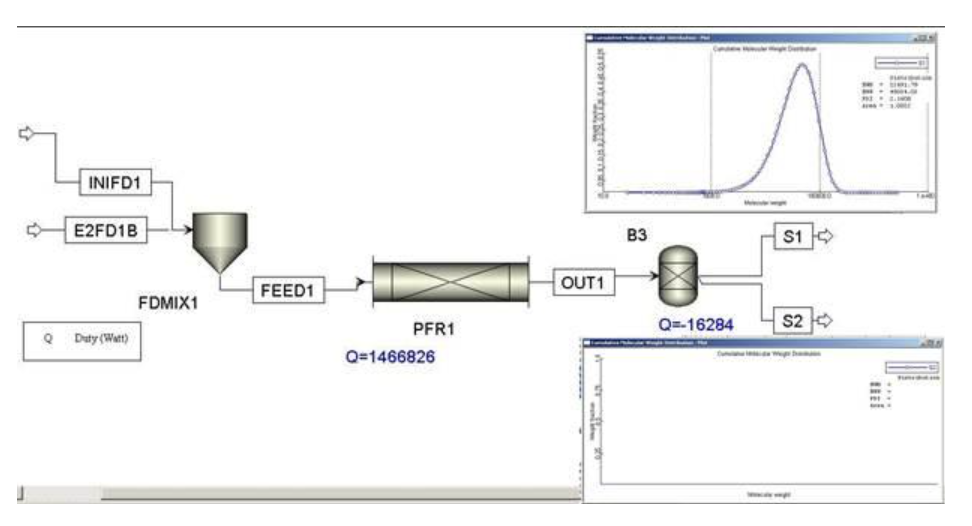
The simulation uses Aspen Plus polymer modeling capabilities to represent the polymerization process. In the base case, the reactor produces two different polymers, but the output stream only provides the overall molecular weight distribution. To address this limitation, a separation strategy is implemented in the flowsheet to isolate each polymer product after the reactor stage.
A separator block is introduced into the process flowsheet to divide the reactor outlet stream into separate polymer streams. By assigning each polymer to different outlet streams, Aspen Plus can calculate and display the molecular weight distribution for each polymer independently. This allows a clearer understanding of polymer properties and improves process analysis for industrial polymer production systems
Process Flow Diagarm
Optimization Strategy
The operational strategy for this simulation involves modeling the polymerization reactor and implementing a separation step to isolate individual polymers. The reactor produces multiple polymers simultaneously, and the outlet stream contains a mixture of these polymers with a combined molecular weight distribution. To obtain separate distributions, the reactor outlet is connected to a separator block that splits the polymer components into different product streams based on their polymer type.
After separation, each stream contains a single polymer product, allowing Aspen Plus to calculate the molecular weight distribution for that polymer independently. The results can then be analyzed to evaluate polymer chain length distribution, average molecular weight, and other polymer properties. This strategy provides a clear method for analyzing complex polymerization processes where multiple polymers are produced together.
Modeling Polymer Molecular Weight Distribution in Multi-Polymer Reactor Systems
This project focuses on the simulation of polymerization processes where multiple polymer products are generated within a single reactor. Using Aspen Plus, the study introduces a separation unit to isolate each polymer stream and evaluate its molecular weight distribution individually. The results help improve product quality analysis and process optimization in industrial polymer manufacturing.
Simulation of Polymer Product Separation for Molecular Weight Analysis
This project investigates the use of separation units in Aspen Plus to isolate polymer products formed simultaneously during a polymerization reaction. By separating the polymers into different streams, the simulation enables accurate calculation of molecular weight distribution for each product. The study supports better characterization and control of polymer properties.
Process Modeling of Multi-Polymer Production and Product
This project demonstrates the use of Aspen Plus for modeling reactors that produce multiple polymer products. The flowsheet incorporates a separator unit to isolate each polymer type, allowing independent analysis of molecular weight distributions. The simulation provides valuable insights into polymer structure, product properties, and process performance.
Projects Insight
Molecular Weight Distribution (MWD) Concept
- Describes the distribution of polymer chain lengths
- Determines mechanical and physical polymer properties
- Important for polymer quality contro
Aspen Plus Polymer Modeling
- Supports advanced polymerization reaction modeling
- Calculates polymer molecular weight statistics
- Provides detailed analysis of polymer distributions
Polymer Production in Reactors
- Multiple polymers may form simultaneously
- Reactor outputs often contain mixed polymer streams
- Combined MWD may hide individual polymer characteristics
Importance for Industrial Polymer Processing
- Helps control polymer product quality
- Supports process optimization and troubleshooting
- Improves understanding of polymer reaction behavior
Role of Separation Units
- Separates polymer products into individual streams
- Allows independent analysis of polymer properties
- Improves simulation accuracy and interpretation
Advantages of Simulation Approach
- Eliminates need for extensive experimental trials
- Enables rapid analysis of different process conditions
- Provides detailed insights into polymer production systems
Conclusion
The simulation of polymer molecular weight distribution is essential for understanding and optimizing polymer production processes. When multiple polymers are produced within the same reactor, Aspen Plus typically reports a combined molecular weight distribution, which makes it difficult to analyze each polymer individually. By introducing a separator block into the flowsheet, the reactor outlet stream can be divided into separate polymer streams, enabling Aspen Plus to calculate individual molecular weight distributions for each polymer product. This approach improves the accuracy of polymer property analysis and supports better decision-making in process design and optimization. The methodology demonstrated in this project highlights the effectiveness of process simulation tools for studying complex polymerization systems and enhancing product characterization in industrial polymer manufacturing.