
CMR+ Precooling Process Simulation for Hydrogen Liquefaction Using Aspen HYSYS
Project Description
Hydrogen is considered one of the most promising clean energy carriers for future energy systems. With increasing global focus on reducing greenhouse gas emissions, hydrogen liquefaction technology plays a crucial role in enabling efficient storage and transportation of hydrogen for industrial and energy applications.
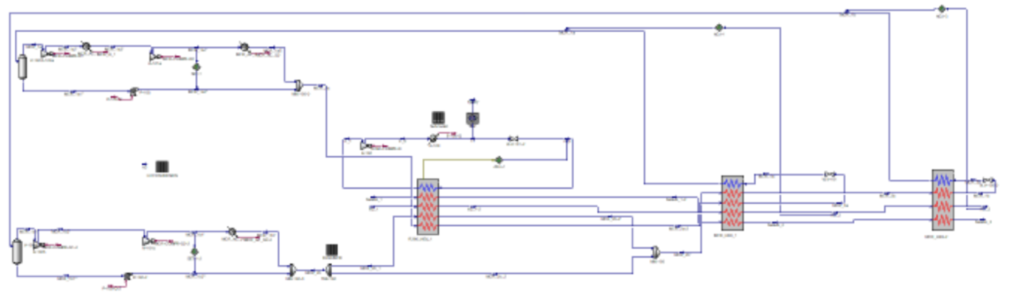
This project focuses on modeling the Cascade Mixed Refrigerant (CMR+) precooling process for large-scale hydrogen liquefaction plants using Aspen HYSYS. The CMR+ process is an advanced refrigeration system that extends the traditional CMR process by incorporating a single propane (R290) refrigeration circuit for partial precooling before the main cryogenic heat exchanger.
The simulation model analyzes hydrogen cooling, mixed refrigerant cycles, and ortho-para hydrogen conversion within the liquefaction process. By simulating these thermodynamic and process conditions, the model helps engineers optimize hydrogen liquefaction plant performance, improve energy efficiency, and support the design of next-generation cryogenic systems
Process Flow Diagarm
Optimization Strategy
The simulation model is developed in Aspen HYSYS using the Hydrogen property package for hydrogen and noble gases, while the Peng–Robinson equation of state is applied for mixed refrigerant calculations. The system consists of two mixed refrigerant cycles connected in a cascade configuration, where hydrogen is progressively cooled from ambient temperature to cryogenic conditions.
The process integrates multi-stage compression, inter-cooling, and heat exchange operations to achieve the required temperature levels for hydrogen liquefaction. A propane refrigeration loop performs initial precooling before the cryogenic stage, while the cascade mixed refrigerant system provides deeper cooling. The model also includes phase separationand pumping operations to prevent liquid formation inside compressors and maintain stable operation.
Simulation of Cascade Mixed Refrigerant Hydrogen Liquefaction Systems
This project analyzes the performance of cascade mixed refrigerant cycles used for hydrogen liquefaction and evaluates cooling efficiency using Aspen HYSYS simulation tools.
Hydrogen Liquefaction Plant Modeling with Advanced Refrigeration Cycles
This study focuses on the design and simulation of large-scale hydrogen liquefaction plants using mixed refrigerant precooling systems to achieve cryogenic temperatures.
Cryogenic Cooling Process Optimization for Hydrogen Storage Applications
This project evaluates advanced refrigeration technologies used in hydrogen liquefaction plants
to improve storage density and energy efficiency
Projects Insight
Hydrogen as a Clean Energy Carrier
- Hydrogen contains high energy density per mass
- Supports decarbonization of transportation and power sectors
- Requires efficient storage and transport technologies
Mixed Refrigerant Compression System
- Multi-stage compressors increase refrigerant pressure
- Intercoolers maintain safe compressor temperatures
- Ensures stable refrigerant circulation
Hydrogen Liquefaction Technology
- Liquefaction increases hydrogen storage density
- Requires extremely low cryogenic temperatures
- Essential for large-scale hydrogen distribution
Ortho-Para Hydrogen Conversion
- Hydrogen molecules exist in two spin isomers
- Conversion occurs during cooling processes
- Important for accurate liquefaction modeling
Cascade Mixed Refrigerant (CMR+) Process
- Uses multiple refrigerant cycles for efficient cooling
- Improves energy efficiency in cryogenic processes
- Enables progressive cooling stages
Cryogenic Heat Exchanger Performance
- Heat exchangers control temperature reduction
- Counterflow configuration improves efficiency
- Critical for achieving final liquefaction temperatures
Conclusion
The simulation of the CMR+ precooling process in Aspen HYSYS demonstrates an effective approach for modeling large-scale hydrogen liquefaction plants. By integrating cascade mixed refrigerant cycles, propane precooling, and ortho-para hydrogen conversion, the model accurately represents cryogenic cooling behavior. Such simulations provide valuable insights for process engineers in optimizing hydrogen liquefaction systems, improving energy efficiency, and supporting the development of sustainable hydrogen energy infrastructure.