
Techno-Economic Analysis
Techno-Economic Analysis (TEA) integrates process modeling with cost evaluation to assess the technical and financial viability of a project. It helps optimize design decisions by quantifying tradeoffs, ensuring solutions are both technically robust and economically justified.
At Simu-Link, we conduct TEA using advanced simulation tools like Aspen Plus and HYSYS, combined with structured cost modeling. Following the AACE 5-Class Cost Estimate Framework, we deliver cost estimates from conceptual (Class 5) to budget-level (Class 3) estimates. Financial metrics such as NPV, IRR, and payback period are included, along with sensitivity and risk analyses using tornado plots and Monte Carlo simulations—ensuring data-driven, investment-ready decisions.
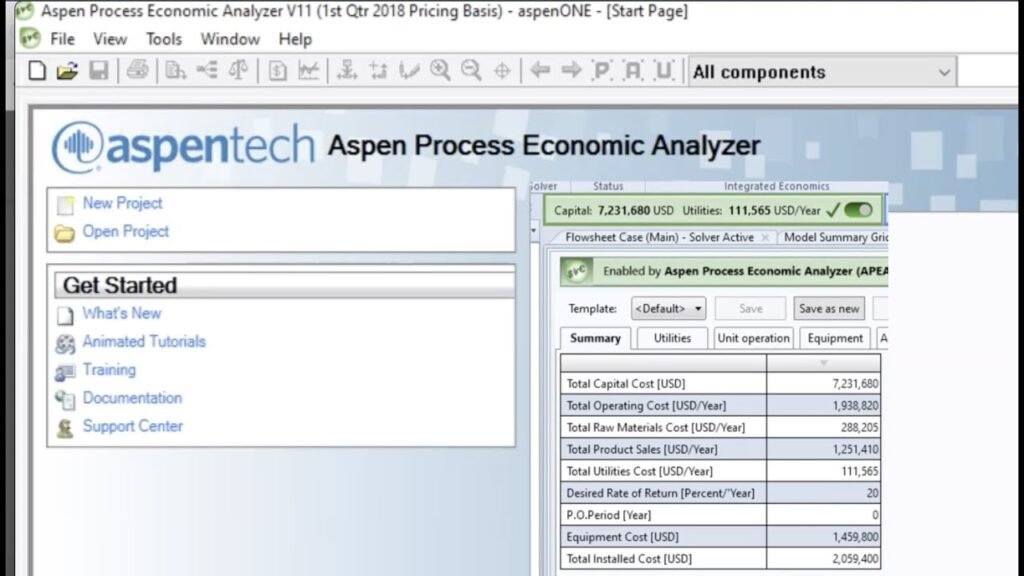
Why Is Techno-Economic Analysis Critical for Process Feasibility?
A techno-economic evaluation is a cornerstone of process feasibility studies, as it bridges the gap between engineering performance and financial practicality. By simultaneously analyzing technical parameters—such as process efficiency, energy consumption, throughput, and reliability—alongside capital expenditure (CAPEX) and operating expenditure (OPEX) in accordance with AACE Cost Estimation Framework, decision-makers can obtain a comprehensive picture of a project’s potential. This dual analysis enables teams to identify the most cost-effective design alternatives, quantify the risks and benefits of various configurations, and determine whether the process meets both performance benchmarks and return-on-investment expectations. Ultimately, it guides informed decision-making, ensuring resources are allocated toward solutions that are technically sound, economically viable, and strategically aligned with long-term business objectives.
AACE Cost Estimation Framework
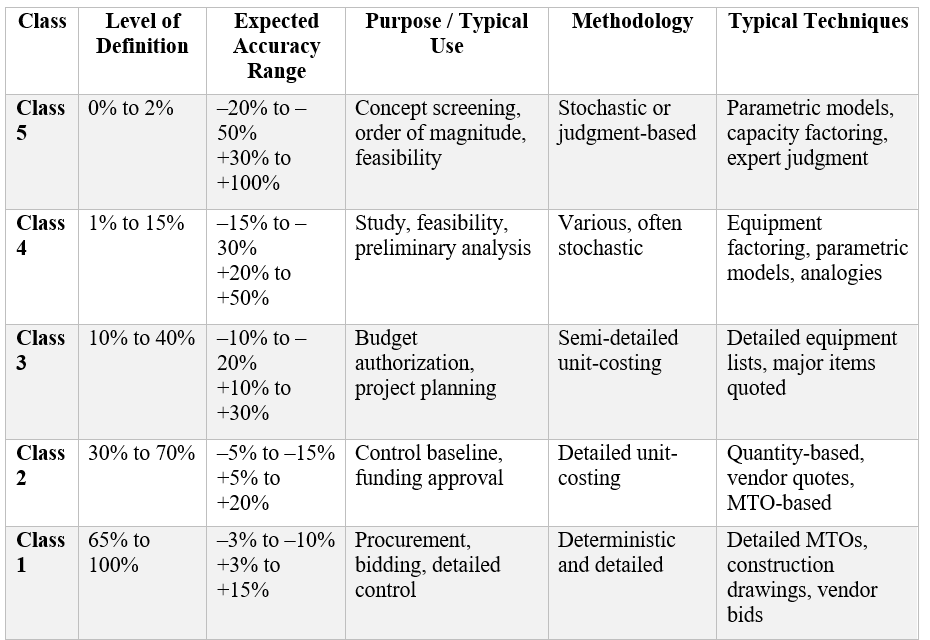
We follow the AACE International’s 5-Class framework to deliver cost estimates with increasing accuracy as project definition progresses. This structured approach ensures clear alignment between engineering detail and cost confidence at every project stage.
Key Deliverables
Our Techno-Economic Analysis provides actionable insights by combining engineering accuracy with financial depth. Each deliverable is designed to support informed, data-driven decisions across the project lifecycle.
Cost Estimation (AACE-Class)
Tiered CAPEX and OPEX estimates aligned with the AACE 5-Class framework, supporting decisions from concept to execution.
Process-Economic Modeling
End-to-end modeling that links process simulation (Aspen Plus, HYSYS) with financial evaluation for accurate feasibility insights.
Financial Viability Metrics
Detailed analysis of NPV, IRR, ROI, payback period, and levelized costs to assess economic performance and viability.
Scenario & Design Analysis
Evaluation of alternative process configurations and market scenarios to identify optimal design paths and enhance decision confidence.

Core Strengths
Our techno-economic analysis provides a comprehensive view of both process efficiency and financial viability, enabling confident, data-driven decisions from concept to commercialization.
- Integrate technical feasibility with financial outcomes for better decisions
- Support investment planning through detailed CAPEX and OPEX modeling
- Identify key cost drivers and financial risks early in project lifecycle
- Deliver insights that strengthen valuation and stakeholder confidence
By aligning engineering precision with economic clarity, we help transform concepts into scalable, investable, and high-impact industrial projects.
Typical Applications
Techno-economic analysis is used to compare process routes, select plant capacity and location, estimate the levelized cost of products such as hydrogen or biofuels, and support funding or investment decisions.
What We Need From You
For a techno-economic analysis we need the process concept and capacity, plant location, feedstock, product and utility prices, financial assumptions (project life, discount rate, tax) and any existing simulation or cost data.
Frequently Asked Questions
What is the difference between techno-economic analysis and a feasibility study?
Techno-economic analysis quantifies costs and returns. A feasibility study uses it together with technical risk and scalability to recommend whether a project should proceed.
Which financial metrics does a techno-economic analysis report?
CAPEX, OPEX, NPV, IRR, payback period and levelized cost of product where relevant, with sensitivity analysis on the key assumptions.
How reliable are techno-economic results at an early stage?
Accuracy depends on how well the project is defined. Early estimates are for screening and comparing options, and are refined as the design develops.