
Simulation of Liquid-Liquid Extraction of Acetone from Water Using MIBK in Aspen HYSYS
Project Description
Liquid–liquid extraction is an important separation technique used in chemical engineering processes to separate components based on their relative solubility in two immiscible liquid phases. In this project, a simulation of acetone extraction from a water mixture using Methyl Isobutyl Ketone (MIBK) as a solvent is performed in Aspen HYSYS. The process demonstrates how solvent extraction can effectively separate acetone from an aqueous stream.
The feed stream consists of a mixture containing 60 mol% water and 40 mol% acetone entering the system at a temperature of 25°C and a pressure of 1 atm with a flow rate of 1 kmol/s. A pure MIBK solvent stream under identical operating conditions is used to extract acetone from the aqueous mixture. The extraction process is carried out using a Liquid-Liquid Extraction column which allows two liquid phases to interact and separate based on their solubility differences.
The simulation uses the NRTL thermodynamic model, which is well suited for highly non-ideal liquid mixtures such as water–acetone systems. Binary interaction parameters are verified and estimated using the UNIFAC LLE method where necessary. The simulation evaluates the separation efficiency and demonstrates that approximately four extraction stages are sufficient to remove nearly 99% of acetone from the aqueous feed stream.
Process Flow Diagram
Optimization Strategy
The operational strategy begins with defining the chemical components—acetone, water, and MIBK—and selecting the NRTL fluid package to accurately represent liquid-liquid equilibrium behavior. Binary interaction coefficients are checked and estimated using the UNIFAC LLE method to ensure the simulation runs without errors. Proper thermodynamic modeling is essential because liquid-liquid extraction strongly depends on phase equilibrium behavior.
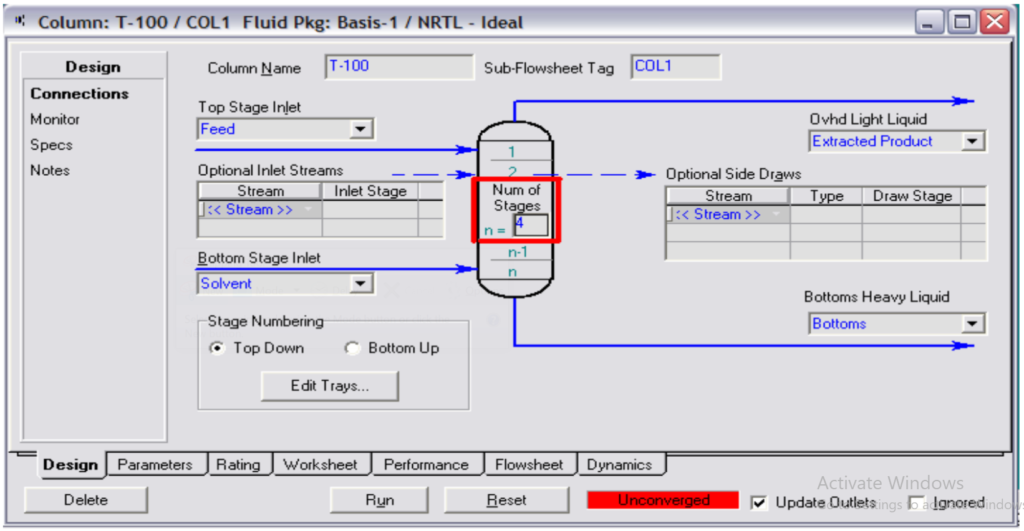
A Liquid-Liquid Extraction column is then configured in the HYSYS simulation environment. The feed stream enters the top stage while the solvent enters from the bottom stage, allowingcounter-current contact between the two liquid phases. The extracted product stream contains the acetone-rich solvent phase, while the bottoms stream contains the water-rich phase. By adjusting the number of trays to four stages, the system achieves efficient acetone recovery with minimal equipment complexity.
Modeling of Acetone Recovery from Aqueous Solutions Using Liquid-Liquid Extraction in HYSYS
This project simulates the separation of acetone from a water mixture using MIBK as an extraction solvent. The Aspen HYSYS model evaluates phase equilibrium behavior and extraction efficiency using the NRTL thermodynamic model. The simulation demonstrates an optimized extraction column design for effective solvent-based separation
Process Simulation of Acetone-Water Separation via Solvent Extraction
This study focuses on the simulation of solvent extraction processes using Aspen HYSYS. A mixture of acetone and water is treated with MIBK in a liquid-liquid extraction column to achieve high separation efficiency. The model analyzes stage requirements, solvent performance, and process operating conditions.
Design and Simulation of a Multi-Stage Liquid-Liquid Extraction Column in HYSYS
This project demonstrates the design of a multi-stage liquid-liquid extraction column for separating acetone from water using MIBK as the solvent. The simulation uses the NRTL thermodynamic model and UNIFAC estimation methods to predict equilibrium behavior and optimize the number of stages required for effective separation.
Projects Insight
Liquid-Liquid Extraction Principle
- Separation based on different solubilities of components
- Requires two partially immiscible liquid phases
- Commonly used in chemical and pharmaceutical industries
Binary Interaction Parameters
- Required for phase equilibrium calculations
- Missing parameters may cause simulation errors
- UNIFAC LLE estimation can predict unknown values
Role of Solvent (MIBK)
- Selectively dissolves acetone
- Immiscible or partially immiscible with water
- Enhances separation efficiency
Extraction Column Design
- Counter-current contact between feed and solvent
- Number of trays influences separation efficiency
- Four trays sufficient for high acetone recovery
Thermodynamic Model Selection
- NRTL model used for non-ideal liquid systems
- Provides accurate liquid-liquid equilibrium predictions
- Essential for extraction simulations
Advantages of Process Simulation
- Reduces experimental cost and time
- Helps optimize operating conditions
- Improves process understanding and design
Conclusion
The simulation of liquid-liquid extraction in Aspen HYSYS provides an effective method for analyzing solvent-based separation processes. In this project, acetone is successfully extracted from an aqueous mixture using MIBK as the solvent in a multi-stage extraction column. By applying the NRTL thermodynamic model and estimating missing binary interaction parameters through UNIFAC LLE, the system accurately predicts liquid-liquid equilibrium behavior. The results demonstrate that approximately four extraction stages are sufficient to remove nearly all acetone from the feed stream, highlighting the efficiency of solvent extraction for separating partially miscible liquid mixtures. This study emphasizes the importance of thermodynamic modeling, proper stage design, and simulation tools in optimizing industrial separation processes.