
Carbon Capture (CCUS) Process Simulation
Simu-Link builds carbon capture process simulations in Aspen Plus and Aspen HYSYS for post-combustion flue gas, natural gas treating and pre-combustion syngas applications.
We model absorber and stripper columns rate-based, size equipment, and estimate the regeneration energy and cost of capture, so you can compare solvents and configurations before committing to a design.
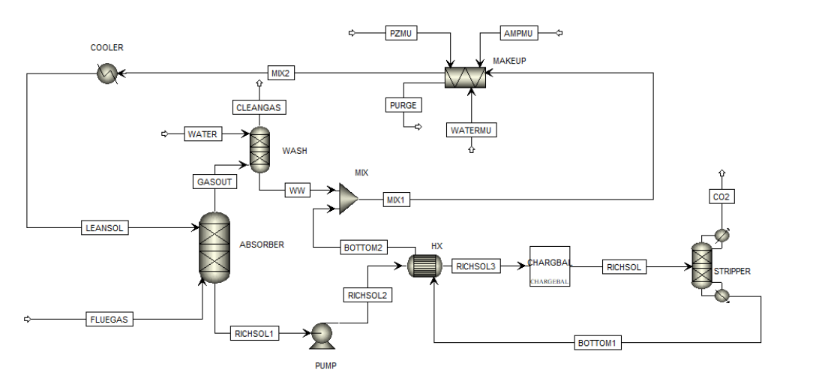
Solvent-Based Carbon Capture Modeling
Our CCUS models cover amine systems (MEA, CESAR1 and other blends), hot potassium carbonate and physical solvents such as DEPG. We set up rigorous electrolyte property methods, rate-based absorber and regenerator columns, and the heat-integration loop between them.
Where plant or pilot data is available, we validate the model against it before using it for optimization or scale-up.
Key Deliverables
Every carbon capture study ends with files and results you can build on.
Validated Aspen Models
Native Aspen Plus or HYSYS files with documented property methods, kinetics and column specifications.
Energy & Solvent Performance
Specific reboiler duty, solvent circulation rate, capture rate and lean/rich loading results.
Equipment Sizing
Absorber, stripper, heat exchanger and pump sizing data from the simulation.
Cost of Capture
Techno-economic analysis with CAPEX, OPEX and cost per tonne of CO₂ captured.
What We Model
Our carbon capture work includes:
- Post-combustion capture from flue gas (MEA, CESAR1, amine blends)
- CO₂ and H₂S removal from natural gas
- Pre-combustion CO₂ capture from syngas (IGCC)
- Hot potassium carbonate and physical solvent processes
- Rate-based absorber and regenerator modeling
- Mineral carbonation and flue gas desulfurization
We also offer ready-made carbon capture models that can be adapted to your flue gas or feed conditions.
Example Carbon Capture Projects
- CO₂ Capture from Natural Gas Flue Gas Using CESAR1 Solvent
- Validation of Plant Data for CO₂ Capture Using MEA
- Low-Pressure CO₂ Capture from Syngas in IGCC Using DEPG
- Techno-Economic Analysis of CO₂ Capture from Syngas Using Potassium Carbonate
- Property Model Uncertainty in Amine Regenerator Simulation
- Olivine Mineral Carbonation for Green Cement Production
Frequently Asked Questions
Which carbon capture technologies can you simulate?
Chemical absorption with amines (MEA, CESAR1 and blends), hot potassium carbonate, physical solvents such as DEPG, and related processes such as mineral carbonation and flue gas desulfurization.
Can you estimate the cost of CO₂ capture?
Yes. We combine the simulation results with equipment sizing and cost estimation to calculate CAPEX, OPEX and the cost per tonne of CO₂ captured.
Can the model be validated against our plant or pilot data?
Yes. We compare model predictions with your measured data and tune property and kinetic parameters where justified, then document the remaining deviations.
Do you have ready-made CCUS models?
Yes. Our library includes several carbon capture models that can be adapted to your gas composition and capture target, which is often the fastest starting point.