
Aspen Plus Process Modeling & Simulation Services
Simu-Link offers Aspen Plus modeling services for chemical, petrochemical, bio-based and carbon-capture processes. Our engineers build rigorous Aspen Plus process simulation models: reactors with detailed kinetics, distillation and azeotropic separations, electrolyte and amine systems, solids and biomass processing, and polymer systems.
Every model is validated against available data and documented, so you can use it with confidence for design, optimization and techno-economic analysis.
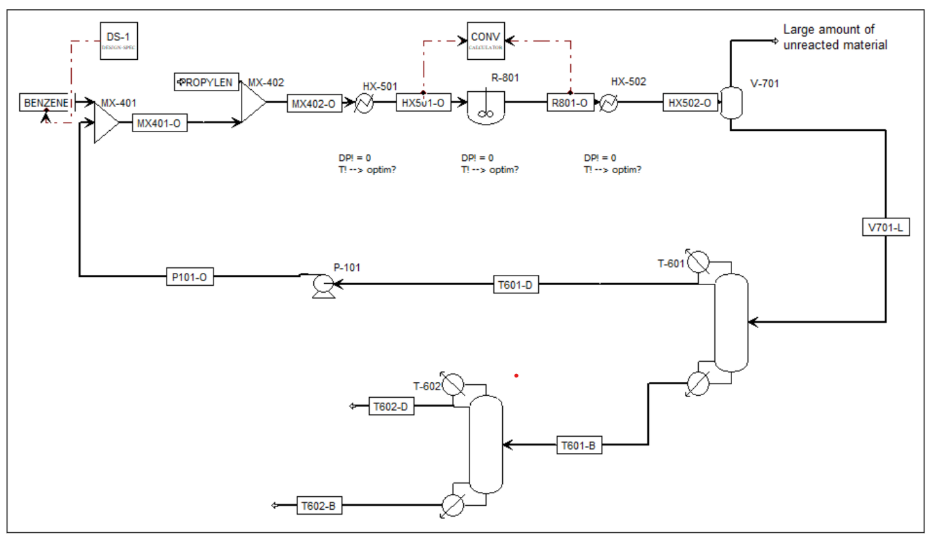
Rigorous Aspen Plus Process Simulation
A reliable Aspen Plus model starts with the right thermodynamics. We select property methods to suit your system, check binary parameters and, where data are missing, regress parameters from VLE or other experimental data.
From there we build the flowsheet with the right level of detail, such as RadFrac columns, kinetic RPlug/RCSTR reactors and converged recycle loops, then use sensitivity analysis, design specs and optimization tools to find better operating points. Where transient behaviour matters, models can be extended to Aspen Plus Dynamics.
Key Deliverables
You receive a working model and the reasoning behind it, so the simulation remains useful long after the project ends.
Aspen Plus Model Files
Converged .bkp / .apwz models with clear block naming and documented inputs.
Thermodynamic Basis
Property-method selection and, where needed, regressed parameters from data.
Sensitivity & Optimization
Case studies showing how key variables affect yield, purity and energy use.
Technical Report
Methodology, results and recommendations ready for design or TEA.
What Our Aspen Plus Modeling Covers
Typical Aspen Plus process simulation work includes:
- Distillation column simulation, including azeotropic and extractive systems
- Reaction kinetics and reactor modeling
- Thermodynamic modeling and parameter regression
- CO₂ capture and acid-gas removal processes
- Biomass drying, pyrolysis and bio-refining
- Polymer processes and molecular-weight distribution
- Heat-pump assisted distillation and energy integration
- Process economics linked to simulation results
Our library of ready-made Aspen Plus projects gives many clients a proven starting point that we then adapt to their own process.
Example Aspen Plus Projects
- Integrated Cumene Production Process with Reaction Kinetics
- Simulation of Heterogeneous Azeotropic Distillation of Water
- Modeling and Performance Evaluation of Vapor Compression Heat Pump Assisted Distillation
- Industrial-Scale Simulation and Optimization of CO₂ Capture from Natural Gas Flue Gas
- Low-Pressure CO₂ Capture from Syngas in IGCC Systems
- Data Regression of UNIFAC-PSRK Group Interaction Parameters
- Biomass Pyrolysis Modeling Using Aspen Plus
- Simulation of Molecular Weight Distribution Separation for Multiple Polymers
Frequently Asked Questions
What kinds of processes do you model in Aspen Plus?
Chemical and petrochemical plants, distillation and separation trains, reactors with kinetics, CO₂ capture and acid-gas removal, biomass and bio-refining processes, and polymer systems.
How do you handle missing physical property data?
We start from the most suitable property method and, where parameters are missing, regress them from experimental data. For example, we have regressed UNIFAC-PSRK group interaction parameters from VLE data.
Can you model reaction kinetics?
Yes. We implement kinetic expressions in RPlug, RCSTR and RBatch reactors and integrate them with separation and recycle loops, as in our integrated cumene production project.
Can the model be used for techno-economic analysis?
Yes. Our models are built to feed directly into CAPEX/OPEX estimates and techno-economic analysis, which we also offer as a service.
Do you deliver the model files?
Yes. You receive the native Aspen Plus files plus a report explaining the assumptions, so your team can run and extend the model.